



Wine Hospitality in Asia
The Business Opportunity That Most Producers Are Missing
6/25/2026
By María Laura Ortiz Chiavetta Winelux Business Insider · June 2026
I have been to Singapore and Kuala Lumpur several times. And in each visit, I have sat at tables that most wine producers never imagine exist — and that most of them are not supplying. Before the end of this year, I will be returning — this time across four Asian markets — and I am going with a clearer eye than ever for what the opportunity actually looks like on the ground.
One evening, eight of us sat in a curved counter facing a chef who said very little and delivered everything. It was an omakase. Each dish was a decision — a flavour sought, a texture chosen, a presentation designed to surprise. The wine service matched that register: the right glass, the right temperature, the right silence before the pour. Nobody was performing luxury. They were practising it.
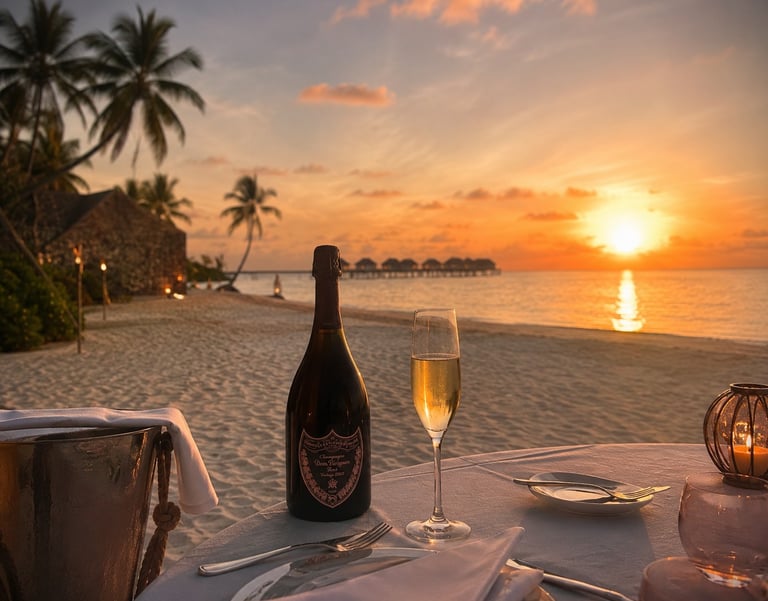
Another memory I return to often: a lobster on the beach in the Maldives, St. Regis, feet in the sand, sun going down. A glass of Dom Pérignon Rosé 2002. No table. No formality. Just the precision of knowing that that wine, at that moment, was the only possible choice. Both experiences — the architectural omakase and the barefoot sunset — share the same logic: wine was not an addition to the moment. It was structural to it.
That is the hospitality model Asia is building right now. And Argentine wine — along with wine from most of the New World — is largely absent from it.
What the Market Is Actually Doing
I attended a Financial Times and Nikkei webinar this week on luxury travel in Southeast Asia. Three executives — from Savills, The Langham, and a leading regional PR consultancy — described a market in structural transformation. The data points are significant: Singapore's family offices have grown from roughly 400 to 2,500 in a few years; Malaysia received a record 38 million tourists last year, surpassing Thailand; Asia now accounts for approximately 40% of the World's 50 Best Hotels. Vietnam has posted 53 consecutive months of positive retail sales.
But the number that matters most for wine is not in any of those figures. It is in the shift the panel described with unusual precision: the Asian luxury consumer has moved from evaluating what a product is to evaluating what it means. From visible opulence to curated intelligence. From the weight of the bottle to the story the sommelier tells before setting it down.
Sherona Shng of The Langham put it directly: travellers today are evaluating "how thoughtfully curated a stay is versus how much is on display." That sentence is a brief for every wine brand that wants to enter this market seriously.
The Wine Hospitality Opportunity — Three Formats
The opportunity is not in retail. It is not in the supermarket aisle or the duty-free shelf. It is in the experiential layer of hospitality — the place where wine earns its position not through placement but through performance.
Format one: the omakase table. The omakase model — chef-driven, course-by-course, intimate — is expanding rapidly across Singapore, Tokyo, and increasingly Kuala Lumpur. These are not wine-pairing dinners in the traditional sense. They are sensory architectures where every element is chosen. Wine that earns a seat at that table must earn it on sensory terms: complexity, specificity of origin, the ability to hold a conversation with what is on the plate. This is precisely where high-altitude Argentine whites — Gualtallary Chardonnay, Luján de Cuyo Semillon — or Patagonian Pinot Noir could be extraordinary. They have the tension, the precision, and the origin story these chefs are looking for. The question is whether the producers are speaking that language when they arrive.
Format two: resort wine programming. The St. Regis Maldives, the Banyan Tree properties, the Six Senses group — these resorts are building wine programming as part of their experiential offer, not as a beverage service. A sunset tasting on the beach. A cellar dinner with a winemaker who has flown in. A curated list where every wine has a reason to be there beyond category or price point. This is where wine becomes a hospitality product in the full sense: designed, narrated, and experiential. The brands that will succeed here are not the ones with the biggest marketing budgets. They are the ones with the most coherent story and the most distinctive sensory profile.
Format three: the B2B education layer. Singapore is becoming a regional hub — logistically, financially, and culturally. Several of my clients are already looking at Singapore as a gateway market precisely because of new tariff agreements and its function as a distribution hub for Southeast Asia. The entry point is not the importer. It is the sommelier community, the hospitality school, the private club. Investing in education before sales is not generosity — it is strategy. The professional who understands a wine's terroir and can narrate it to a table of eight at an omakase counter is the most powerful commercial asset a producer can have in this market.
Gen Z and the New Luxury Logic
I have two children who belong to Generation Z. I watch how they move through the world of luxury with a kind of clarity that older generations — including mine — did not have at their age. They prefer enjoyment over exposure. They do not post the label; they share the moment. They are, in a sense, the purest expression of what the FT panel described as the new luxury consumer.
But I study Gen Z beyond my own household, because my children are — as most parents eventually discover — not entirely representative.
What the data and my direct observation converge on is this: Generation Z in the luxury space is not anti-consumption. They are anti-accumulation. They spend, often significantly, but they spend on experiences, on meaning, on things they can feel rather than display. In wine, this translates into a preference for producers with a genuine relationship to the land, for wines that taste like somewhere specific, and for stories that hold up under scrutiny. Sustainability is not a marketing message for this consumer — it is a filter. They will look it up. They will ask. And if the answer is performative, they will move on.
The wine brands that will build loyalty with Gen Z in Asia are the ones that can demonstrate — not claim — a coherent relationship between what they make, where it comes from, and what they believe. This is not a communications challenge. It is a brand architecture challenge. And it starts in the vineyard, not in the campaign.
The Business Ideas Worth Pursuing Now
For producers, importers, and wine businesses looking at Asian markets, I would propose the following entry angles — each grounded in what the market is actually building:
Omakase wine partnerships. Approach two or three omakase restaurants in Singapore with a curated selection and a genuine pairing proposal — not a price list, but a sensory argument for why your wine belongs on that counter. Offer a winemaker dinner as the opening gesture.
Resort activation programmes. Identify three to five luxury resort groups operating in Southeast Asia and the Maldives and build a proposal around wine experiences as hospitality programming — sunset tastings, winemaker visits, curated lists with narrative. Position it as a content asset for the resort, not as a sales call.
Sommelier education as market entry. Before approaching any retailer or distributor in Singapore or KL, invest one year in the professional community. Host a masterclass. Sponsor an industry dinner. Build the knowledge base that makes every future sale easier and more defensible.
Gen Z content architecture. If your brand does not have a story that a 26-year-old can find, understand, and share in under two minutes, you do not have a Gen Z strategy. This is not about TikTok. It is about clarity of origin, authenticity of practice, and the courage to say something specific rather than something safe.
The hub logic of Singapore. Use Singapore not only as a market but as a demonstration platform — the city where you establish your sensory positioning, your professional relationships, and your narrative. Let that radiate to KL, to Jakarta, to Ho Chi Minh. The tariff environment and the logistics infrastructure make it the most rational first step.
The Wine That Asia Is Waiting For
It is not the wine with the highest score. It is not the wine in the heaviest bottle. It is the wine that gives the consumer — whether they are a Gen Z collector in Singapore, a bleisure executive in Tokyo, or eight people at a counter watching a chef work — something to feel and something to say.
That wine already exists. In Mendoza, in Patagonia, in the volcanic soils of Argentina's high-altitude regions. The gap is not in the product. It is in the conversation.
The wine that Asia is waiting for already exists. The producers that will earn a place at those tables are not the ones that arrive with the best price list. They are the ones that arrive with the clearest idea of what they stand for — and the patience to let the market come to them.
María Laura Ortiz Chiavetta is a wine strategist and luxury brand consultant. She is Academy Chair at World's Best Vineyards, Country Ambassador for the International Wine Challenge, and LATAM Brand Manager for Tim Atkin MW. Her book The Luxury Pairing Method launches 14 July 2026.
The Luxury Pairing Method — Pre-order now on Amazon. Launching 14 July 2026.
The Maldives
