

When Chanel Buys a Vineyard, It Is Not Buying Wine. It Is Buying Time.
6/18/2026
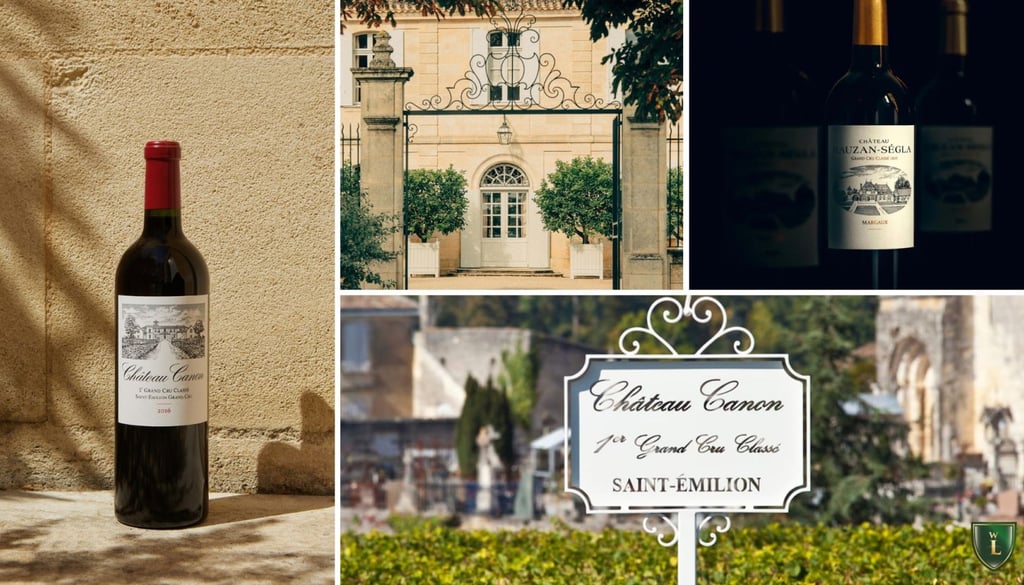
On 8 June 2026, in a private room in Madrid, a sommelier was presenting the wines of Château Canon to a group of wine professionals. On the table stood bottles from Margaux and Saint-Émilion. On the screen appeared limestone soil profiles, parcel maps and eighteenth-century underground galleries. Nothing in that room mentioned Coco Chanel. And yet, the logic governing every technical decision — the reduction of new oak, the introduction of 900-litre foudres, earlier harvest dates than neighbouring estates, the triple grape selection process — was exactly the same logic that built one of the most enduring luxury empires of the twentieth century.
Chanel does not talk about its investments in wine. That, too, is a strategic decision.
A Portfolio Built in Silence
The Wertheimer family — owners of Chanel — began its Bordeaux journey in 1994 with the acquisition of Château Rauzan-Ségla, a Second Growth in Margaux with more than three centuries of history and a potential that previous ownership had failed to fully realise. Two years later, in 1996, came Château Canon in Saint-Émilion, a struggling vineyard that required almost complete replanting. In 2015, they added St. Supéry in Napa Valley. In 2019, Domaine de l'Ile on the island of Porquerolles in Provence. For three decades, they have also controlled Ulysse Cazabonne, one of Bordeaux's leading négociants, and more recently added Lavinia, the specialist wine retail chain operating across Spain, France and Portugal.
In April 2026, Chanel consolidated all its wine estates under a single corporate identity: Les Vignobles. Four estates. Two countries. One philosophy. Each property retains its own terroir identity. What becomes unified is the vision.
What Chanel has built over three decades is not a collection of châteaux. It is a vertical ecosystem controlling production, distribution and retail. From vineyard parcel to consumer's glass, through the négociant and the point of sale. That is not diversification. It is strategic integration.
The Investment Model Few Luxury Brands Truly Understand
When major luxury houses invest in wine, they generally do so in one of two ways: as a brand extension or as a pure financial asset. LVMH chose the first route — Moët, Veuve Clicquot, Ruinart, Château Cheval Blanc — building a portfolio where wine amplifies the broader brand universe. It is a brilliant model, but a visible one, designed for the market and impossible to ignore.
Chanel chose something different. Its acquisitions do not appear in advertising campaigns. Rauzan-Ségla does not carry the double-C logo on its label — it bears a design by Karl Lagerfeld, certainly, but one that remains restrained, elegant and understated. Canon is not sold as "Chanel's wine." It is sold as Canon.
This discretion is not modesty. It is positioning. Chanel understood that in the ultra-premium wine segment, an explicit association with a fashion house can become noise that distracts from the authenticity of terroir. What the Château Canon customer purchases is not Chanel. They purchase thirty years of quiet investment in limestone soils, patient replanting, the gradual reduction of new oak and harvest dates earlier than anyone else in the region. They purchase an agronomic decision made in 2015 whose result only becomes visible in the glass in 2025.
That is thinking in decades. Not quarters.
What Canon Teaches About Luxury as Process
During today's masterclass, the presenter described the management of Château Canon since 1996 with a phrase that summarised everything: The first ten years were spent understanding the parcel-by-parcel terroir. The next years were spent restructuring it. The most recent years have been dedicated to refinement. Thirty years of work with a clear horizon and no shortcuts.
The restructuring was literal. When Chanel acquired Canon, it inherited a vineyard with poorly positioned Cabernet Sauvignon and ageing vines with declining performance. They removed them. They replanted with 70% Merlot and 30% Cabernet Franc — varieties that the clay-limestone terroir of Saint-Émilion translates into elegance. A decision that required decades to reveal its full impact. A decision that can only be taken when the time horizon is not the next balance sheet but the next generation.
Today, with vines approaching an average age of thirty years — considered by the technical team to be the point of maximum expression — decisions continue to follow the same logic. No parcel has been declassified since 2015. The proportion of new oak has been reduced to 60% — previously it was higher — and since 2020 the estate has incorporated 900-litre foudres and cement tanks to moderate oak influence and preserve fruit purity. Every adjustment points in the same direction: Back to the soil. Back to the vine. Away from oenological artifice. And in 2024, all three Bordeaux estates achieved organic certification — a move that arrived without a press release, without a campaign, almost in silence. Like everything Chanel does in wine.
That consistency extends even to the second wine. Croix Canon is not a by-product of the grand vin. It is vinified by the same technical team, under the same standards and according to the same philosophy of selection. The difference lies in the origin of the parcels and the intended profile — more accessible, more fruit-driven, designed for earlier enjoyment. But the dignity of the process remains identical. At Chanel, there is no Category B.
This is the same language Chanel speaks through its fragrances and its couture. Time as a raw material. Savoir-faire as an investment that cannot be measured within a single fiscal year. Creation as a long-term act.
The philosophical coherence between a tweed jacket and a bottle of Canon is not accidental. It is brand architecture operating on a timescale of decades.
The Angle the Market Has Yet to Fully Understand
What the fine wine sector often overlooks is that Chanel did not invest in wine to sell wine. It invested in wine to complete a universe of value that its clients already inhabited. The collector of Chanel No. 5. The haute couture client. The fine jewellery customer. All of them share a relationship with time, scarcity and the irreproducible. Terroir-driven wine is the natural extension of that universe, not as a consumer product but as an experience of belonging.
The creation of Les Vignobles in 2026 confirms that Chanel is moving from silent accumulation to the conscious construction of a wine identity. Bringing four estates together under a single banner — while preserving the individuality of each terroir — is the same move the house made with its fashion divisions: A portfolio architecture where every element retains its own voice while responding to a common grammar.
For those of us working at the intersection of luxury and wine, this is the model worth studying. Not because it is replicable — it is not, certainly not at the same level of capital investment. But because it articulates a truth the sector needs to hear: Luxury wine is not built through marketing. It is built through time, through soil, through technical decisions that no one will see for years, and through the discipline of not explaining too much.
Chanel has spent thirty years not explaining too much. And this afternoon in Madrid, Château Canon spoke entirely for itself.
This afternoon I had the opportunity to confirm it in the glass. The Canon grand vin arrived with fresh cherry, abundant rose notes and that mineral salinity that stimulates salivation — the unmistakable signature of limestone soils that cannot be simulated. Elegant. Genuinely refined. Its tannins already integrated, yet possessing the structure required for further evolution. Croix Canon, by contrast, was juicy and immediate. More fruit. More accessibility. And yet produced according to exactly the same standards as its elder sibling. That is precisely the intelligence of the model: There is no neglected second wine, because at Chanel consistency of quality is not optional.
Rauzan-Ségla closed the tasting sequence with violet and cassis on the nose, and on the palate that creamy texture only fully ripe Cabernet Sauvignon grown on the deep gravels of Margaux can deliver — liquorice, spice and raspberry emerging in the background. Ségla, its second wine, surprised with its fluidity and with a long finish that never apologised for being "the second wine." Both confirmed the same thing: Thirty years of silent investment have a recognisable flavour. It is called precision.
María Laura Ortiz Chiavetta is an international strategic consultant in luxury wine, Director of Winelux and founder of Winifera. She is LATAM Brand Manager for Tim Atkin MW and a member of the Great Wine Capitals Expert Panel.
