What the dupe cannot copy
Captives, chromatography and the problem of an art without copyright
SCENT AND STORY
5/2/2026
Stéphanie said it with a precision that stayed with me long after the panel ended. She paraphrased it like this: you can replicate a perfume to 95% using synthetic accords and sell it without naming the source. There is no law preventing it. Perfume is the only art for which that is completely legal.
She did not say it with indignation. She said it like someone describing an engineering problem that still has no solution. And that calm, paradoxically, was what made the sentence carry more weight.
The debate around dupes in perfumery is usually framed as a conversation about consumer ethics. Is it acceptable to buy a copy? Is it dishonest to wear something that smells identical without paying the price of the original? Those questions have their place, but they interest me less than the structural problem beneath them.
Perfumery is the only art without copyright protection over its central work. Not over the bottle, not over the name — those are protected. Over the formula itself, over the olfactory composition as intellectual creation, there is no equivalent protection to what exists for a song, a novel or a painting.
That is not a regulatory accident. It is an implicit decision about the status of smell as an aesthetic sense. And it says something uncomfortable about how Western culture hierarchises perception.
In the world of wine, we have spent decades building partial responses to this same problem: appellations of origin protect territory, not flavour profile. You can plant Pinot Noir anywhere in the world and call it Pinot Noir — what you cannot do is call it Burgundy if it does not come from there. The label is protected. What is inside is not. Perfumery does not even have that.
During the panel at Paris Perfume Week, Stéphanie explained the only technical mechanism currently capable of creating real inimitability within a formula: captive molecules.
A captive is a patented synthetic molecule available exclusively to perfumers working with the house that developed it. When a captive molecule enters a formula in sufficient proportion, it creates a profile genuinely impossible to replicate exactly because the ingredient does not exist in any open catalogue.
But there are two limitations Stéphanie acknowledged with an honesty I appreciated. First: the effectiveness of the captive depends on its proportion within the formula. If the molecule is present merely as decorative accent, a competitor can approximate the effect closely enough using substitutes. Only when the captive is structurally central — when it defines the accord rather than decorating it — does inimitability become real. Second: patents last twenty years. Afterwards, the molecule enters the public domain and the advantage disappears. What was once a barrier becomes a commodity.
Those are two limitations the industry knows well and rarely states aloud.
The de Laire bases presented by Symrise during the week illustrate a complementary strategy — and one more durable than the individual captive.
Since 1876, when the history of what would eventually become Symrise began, there existed the practice of developing bases: complex accords, stabilised, built upon knowledge accumulated over generations and ready to be incorporated into a formula as a unit with its own personality. The relaunch of Ambre 83 and Ambre 84 in 2016 was not nostalgia. It was a strategic declaration: a base constructed with proprietary captives, high-quality naturals and decades of internal savoir-faire creates a complexity genuinely difficult to dismantle from the outside.
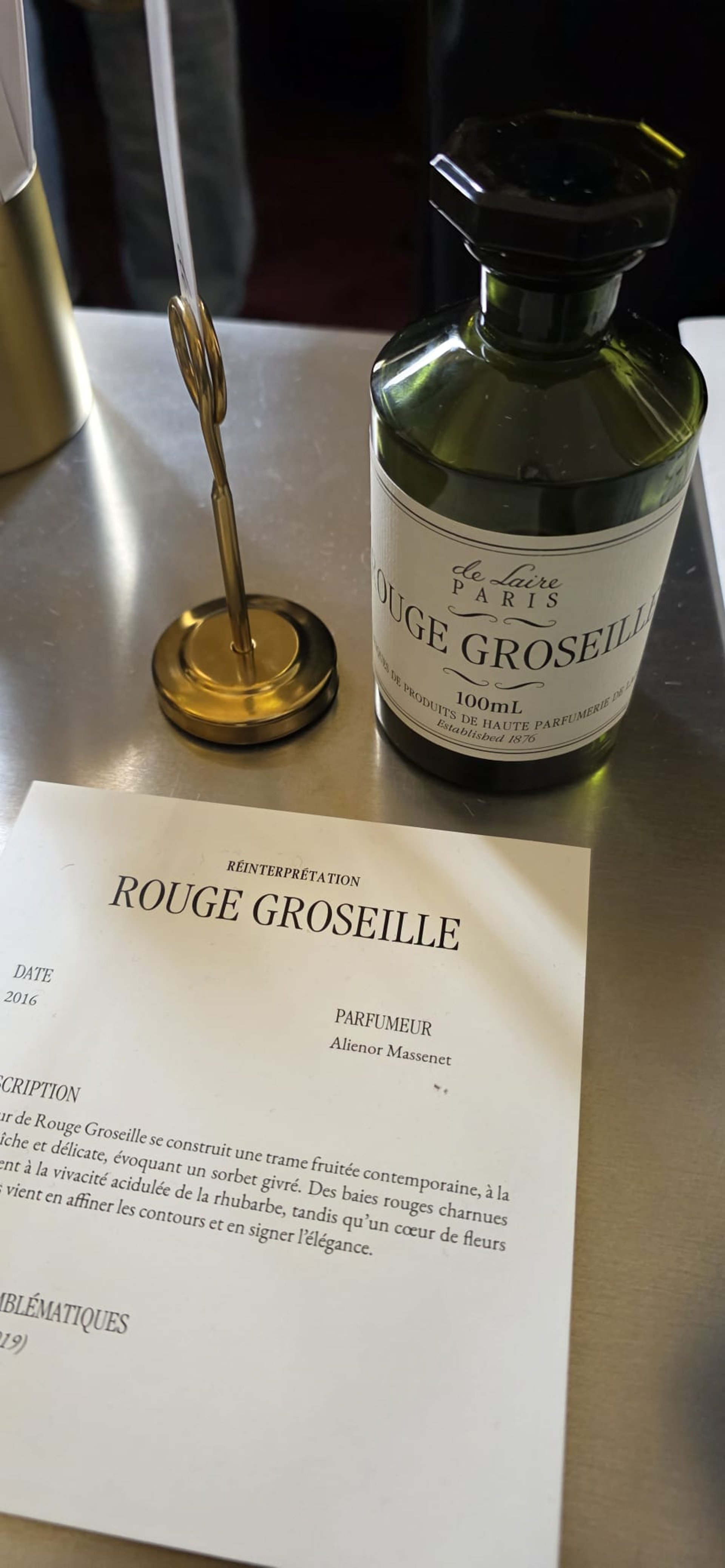
Rouge Groseille — one of the bases created during that relaunch — was present at the de Laire Paris stand: dark green glass bottle with pharmaceutical-style label, “Established 1876”, the inscription saying everything about the difference between real heritage and narrated heritage. I smelled it. There is something in the foundation of that composition — a cohesion between blackcurrant, rhubarb and the floral heart — that cannot be dismantled into components because it exists in none of them individually. It exists in the relationship between them, built through years of adjustment and refined by someone who knows that base the way one knows one’s own handwriting. The Symrise captive is there, invisible, doing work no chromatographic analysis could fully reproduce. Not because it is secret — because it is complex in a way imitation cannot reach without access to the same system of knowledge.
That is exactly what the dupe cannot copy.
During the panel, the audience raised the most philosophically interesting question of the session: if formulas were someday to receive legal protection, how would the difference between a dupe and an inspiration be defined?
Stéphanie proposed something I found elegant in its rigour: a criterion of objective chromatographic similarity. Just as SACEM in music has thresholds of melodic similarity to determine plagiarism, there could exist a standard establishing that above a certain percentage of correspondence in chromatographic profile, we are facing a copy. Not a shared trend, not a legitimate inspiration — an unauthorised reproduction.
The problem is that such a standard does not exist. And while it does not exist, the only real protection lies in captives, highly complex naturals, and the willingness of the market to value what it cannot see.
The legal expert participating in the panel introduced a distinction that reorganises the entire conversation: the difference between a dupe and counterfeiting is not one of degree but of nature.
Counterfeiting pretends to be something else. It sells a bottle labelled Chanel N°5 without being Chanel N°5. It uses the name, logo and iconography of a brand without authorisation. Against that, robust legal tools exist — trademarks, design patents, trade dress protection. The courts possess extensive jurisprudence and the outcomes are relatively predictable.
The dupe does not pretend to be something else. It explicitly says: it smells like X but costs Y. It does not use the name. It does not copy the bottle. It copies the olfactory accord — and that is precisely what the law does not protect. Not through negligence. Through absence of consensus over whether smell deserves the same protection as sight and hearing.
That distinction matters because it defines the type of problem we are facing. Counterfeiting is a legal problem with legal solutions. The dupe is a structural problem requiring structural responses: complexity making 95% similarity qualitatively different from 100%, materials whose richness of hundreds of interacting compounds cannot be perfectly reproduced, and origin narratives giving consumers reasons to value what they cannot directly perceive.
One panel participant offered a perspective initially sounding counterintuitive but possessing real logic: being copied is an indicator of notoriety. Nobody dupes something irrelevant.
There is truth in that. And there is also a meaningful economic argument: the consumer buying a dupe at twenty may become the original’s client at thirty-five, once budget and palate have evolved together.
But that argument has a limit the industry tends to ignore. It works when the dupe is clearly inferior — when the quality difference is perceptible and keeps the original desirable. When synthetic chemistry allows approximation to 95% fidelity using open-catalogue materials, the dupe is no longer an entry point into the original’s market. It is a substitute. And that changes everything.
What remains as real differentiation — in the absence of legal protection and with synthesis becoming increasingly precise — is not the accord itself. It is what the accord contains that cannot be dismantled and replicated: the captive unavailable in any open catalogue, the absolute costing ten times more than its synthetic equivalent and whose complexity of hundreds of interacting molecules cannot be perfectly reproduced, the base built upon decades of internal knowledge giving cohesion to everything without anyone being able to name exactly why.
Brands building differentiation solely upon what is visible — the accord, the packaging, the marketing narrative — are structurally vulnerable by construction. Imitation can always reach as far as visibility has gone. What imitation cannot reach is what was built beneath the visible: the systems, decisions and accumulated knowledge producing the result as consequence.
Stéphanie summarised it precisely: perfume has no copyright because nobody has yet convinced institutions that smell deserves the same legal protection as sight and hearing. But until that cultural battle is won, the only protection available is complexity itself. Creating something so well constructed, with materials so specific and knowledge so accumulated, that the effort required to copy it exceeds the benefit.
It is not the ideal solution. It is the only one available. And it requires building in layers the speed of the market would discourage — but which time itself transforms into something inimitable.
What truly protects what you create — the name, the packaging, or what is inside and nobody can see? And if the answer is only the first two, what does that say about the strength of your differentiation?
This chronicle forms part of the material shaping Diario de Nariz Vol. IV — a journey through the universe of niche and ultra-niche perfumery: Paris Perfume Week, Niche Show London, Grasse Perfume Week, and the perfumeries preserving the soul of the craft.
Photographs: Rouge Groseille bottle by de Laire Paris, Established 1876 · Panellist on blue stage at Paris Perfume Week by NEZ.
María Laura Ortiz Chiavetta — Aroma Storyteller
Winelux Scent & Story