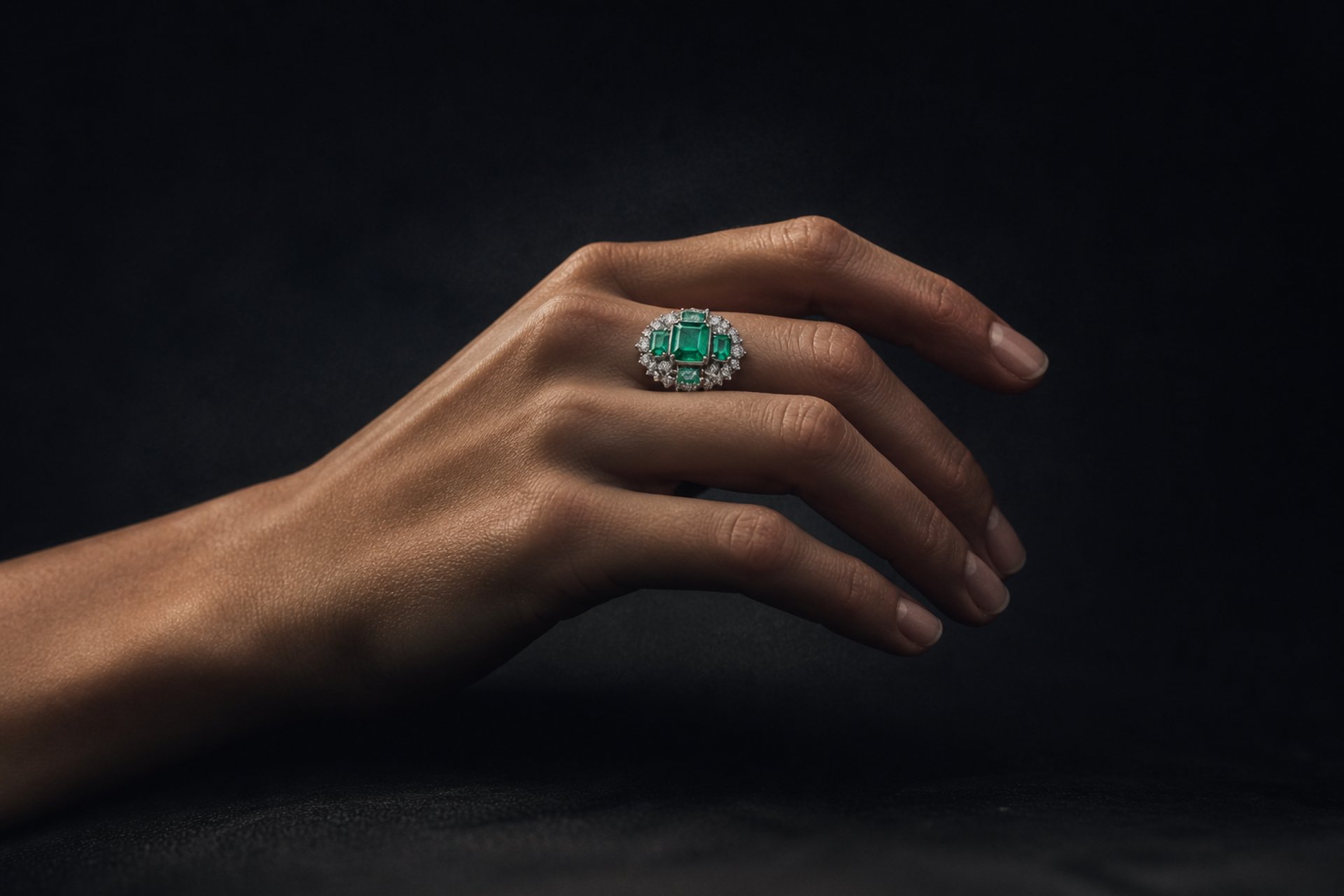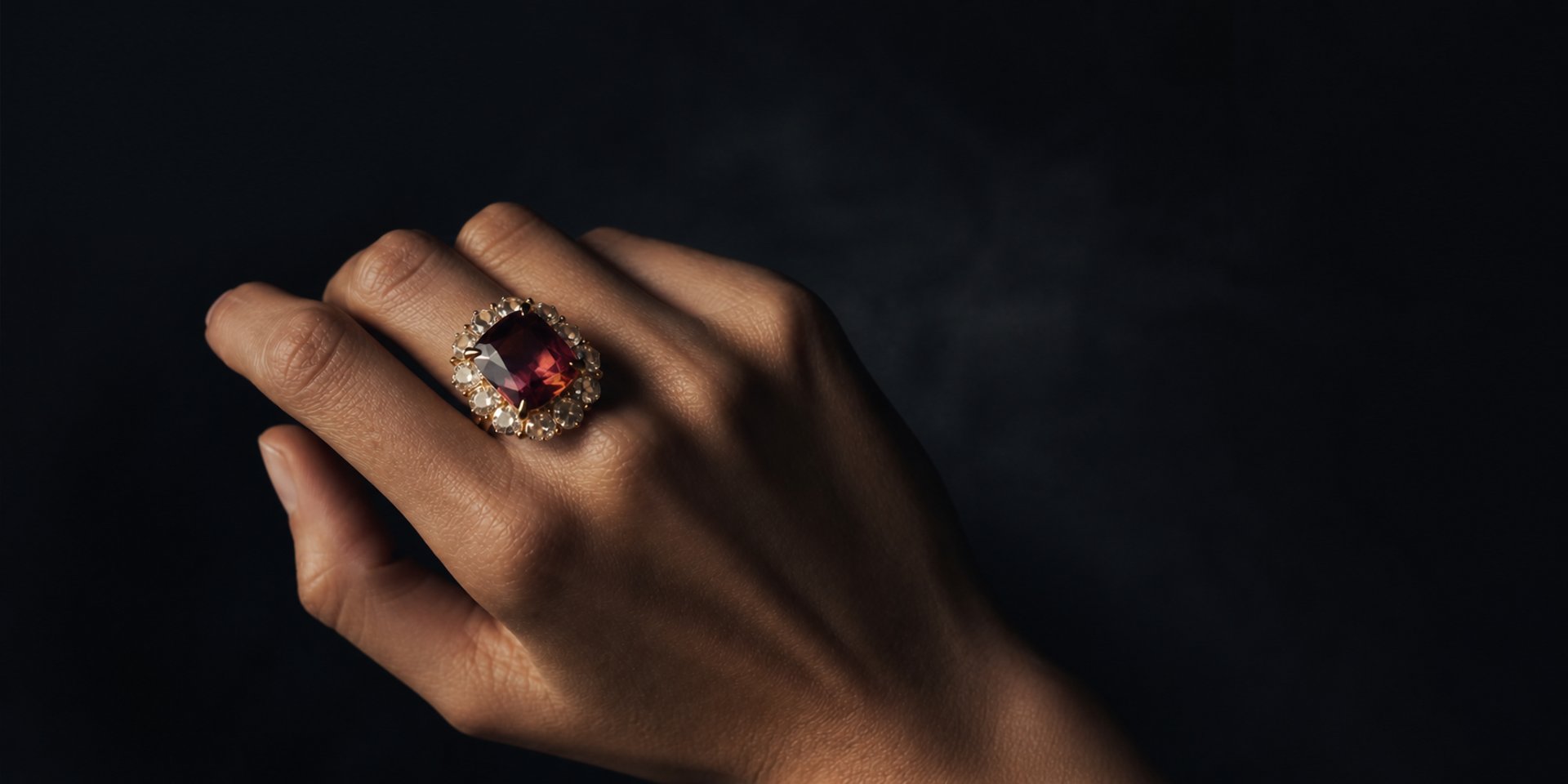
What cannot be photographed
A visit to the heart of Graff, in London
HIGH JEWELRY
5/4/2026
There is an unwritten rule among master jewelers: when they want to evaluate someone else’s work, they do not look at the stone first. They turn the piece over.
The reverse is where everything is revealed. The side no one shows, that no photograph captures, that no client will ever see once the jewel is worn. And yet, in Graff’s workshops in Mayfair, that invisible face receives exactly the same attention as the visible one. Three stages of polishing. Surfaces no one will ever touch, polished as if they were meant to be displayed.
That was the first thing I understood when Sam — General Manager of the workshop — showed me one of the finished pieces and turned it over without my asking.
“If you ever see jewelers inspecting someone else's work, they'll always turn the piece over first. Because that's where you see what sort of craftsmanship's gone into the piece. You can be blinded by diamonds. But if you look at the back, you can really see what care has been taken.”
I did not need further explanation. In that gesture, everything was there.
A Building That Does Not Announce Itself
Graff’s workshop occupies two buildings on Hogarth Street, in the heart of Mayfair. From the outside, there is no sign indicating what happens inside. No logo on the door. No display window. Discretion is not a communication strategy — it is the natural consequence of a place that does not require an audience.
Inside, the space is both dense and silent. Dozens of artisans work at individual stations, each on a different piece, at a different stage of the process. The noise is technical — polishing motors, precision tools — but the atmosphere is one of absolute concentration. No one looks up unnecessarily.
Nothing can be photographed. The restriction does not surprise once one understands what is being seen: pieces that do not yet exist for the world, prototypes of collections without a public name, diamonds that in a matter of weeks will be in showcases in Paris or New York, or in the hands of someone whose name will also remain unspoken.
“Why is it not possible to take pictures? Now I need to memorize everything,” I said aloud at one point.
And that is exactly what I did.
Engineering Before Design
What surprised me most was not the beauty of the pieces — although it was evident — but the logical sequence that precedes them.
Each single-stone ring begins with a scan. The diamond is placed in a small white box that captures every facet in high resolution. That digital map defines everything that follows: the bezel is cut specifically for that stone, not for a generic stone of that carat weight. The geometry of the setting maximises light flow, minimises visible metal, and secures the stone without pressure.
“All you see is diamond,” Sam explained.
Graff produces approximately one hundred single-stone rings — three carats and above — each month. None are repeated. Each is built from scratch for the stone it will hold.
When I said it aloud — “So it’s more than design; it’s engineering” — Sam nodded with the precision of someone who has been waiting years for it to be named correctly.
“I always think jewellery is a combination of two. It has to function, but it has to be beautiful. So there is definitely engineering and design combined.”
Beauty without function does not last. Function without beauty does not matter. High jewelry exists exactly at that intersection — and Graff inhabits it with a discipline that inevitably recalls the world of great wines.
The Chain of Origin
The stones arrive in London already cut. The cutting takes place in South Africa — where some of the most important diamonds in the world have been extracted and where Graff has operated since its origins. On Hogarth Street, only finished stones are worked.
That chain — geology, extraction, cutting, travel, assembly — follows a logic that anyone in the wine world immediately recognises. A great Burgundy is also the result of an unrepeatable chain: the specific composition of the soil, the conditions of a vintage that will not return, the decisions of a grower who interpreted that year in a particular way. What reaches the glass is the visible end of a long process, largely invisible, that determines everything that is perceived.
At Graff, what reaches the showcase is the visible end of a chain that began in the earth, millions of years ago. The diamond was not designed. It was formed under pressure and time. What the workshop does is reveal what was already there.
Time as Argument
There is a scene I did not forget.
Sam was showing the assembly system of a necklace — more than one hundred and fifty individual pieces, each numbered, each in its labelled bag, waiting to be joined in the correct order. The complete process, from the first prototype to the finished piece, could take four months.
“We are quite efficient,” he said, without irony. “Because we’re all in one building. We never have to wait for stones. We never have to wait for a setter. And if we need a decision made, Mr. Graff is always here.”
Four months for a necklace. One hundred unique rings per month. Three polishing stages per piece. Invisible surfaces treated as if they were visible.
In the wine world, we understand this instinctively: time is not a cost. It is part of value. A wine that cannot wait cannot be great. A winery that cannot sustain that time cannot produce what it promises.
Graff brings the same argument to jewelry with the same severity. Nothing is accelerated here, because it cannot be accelerated without losing exactly what justifies the price — and more importantly, what justifies trust.
What Photography Cannot Capture
At the end of the visit, Sam placed a finished piece on the polishing table. Ninety-one carats of yellow diamonds, fifty-eight of white. The total weight approached one hundred grams — the limit Graff sets to ensure that something so spectacular is also, in his words, “comfortable to wear.”
I held it carefully. It was exactly what I expected it to be, and something I had not anticipated: it had movement. The internal articulations — designed and built so the piece adapts to any body — made it respond to gesture in a way no photograph can transmit.
“People are sometimes surprised how dirty the process looks right until the end,” Sam said. “And it just comes to life.”
That phrase stayed with me.
The highest level of luxury is not born finished. It is born in wax queens, in high-resolution scanners, in labelled bags with pieces that seem to have no form, in months of work no one will ever see. What is visible at the end — the stone, the light, the movement — is the consequence of everything that remained invisible.
Like wine that does not reveal its greatness until time allows it. Like perfume that does not unfold until the skin transforms it. Like any form of real value: there is always more beneath the surface than what appears.
Jewelers know this. That is why they always turn the piece over first.
María Laura Ortiz is a strategic consultant in wine and luxury, founder of Winelux, author of The Luxury Pairing Method (2026), and Wine Voice for Wine Searcher. She travels regularly to London, South Africa, Argentina and Spain, covering the intersection between wine and luxury in all its forms.
Next in the series — Article II: Tiffany, London. The luxury that invites.