

The Winery as a Cultural Space
Experiences That Transcend the Glass
3/26/2026
Introduction: Wine Is Not Only Drunk — It Is Lived
In the world of luxury, the consumer no longer seeks only products: they seek symbolic belonging, curated emotion, and living narrative.
And few categories have as much potential to generate this as wine.
When a winery is conceived as a cultural space — not only a productive one — it ceases to be a place of production and becomes a stage of symbolic value. There, the visitor does not only taste: they interpret, remember, transform.
What Does It Mean for a Winery to Be a Cultural Space?
It means that wine:
Is embedded in an experience with aesthetic, symbolic, and emotional content.
Is connected with art, territory, architecture, and thought.
Becomes a vehicle for conversation, not only for consumption.
Château La Coste (France): contemporary art, landscape interventions, signature architecture. Wine is one of the voices, but not the only one.
Elements That Turn a Winery into a Cultural Space
Aesthetic curation of the space. Light, materials, proportion, flow: every detail communicates sensitivity.
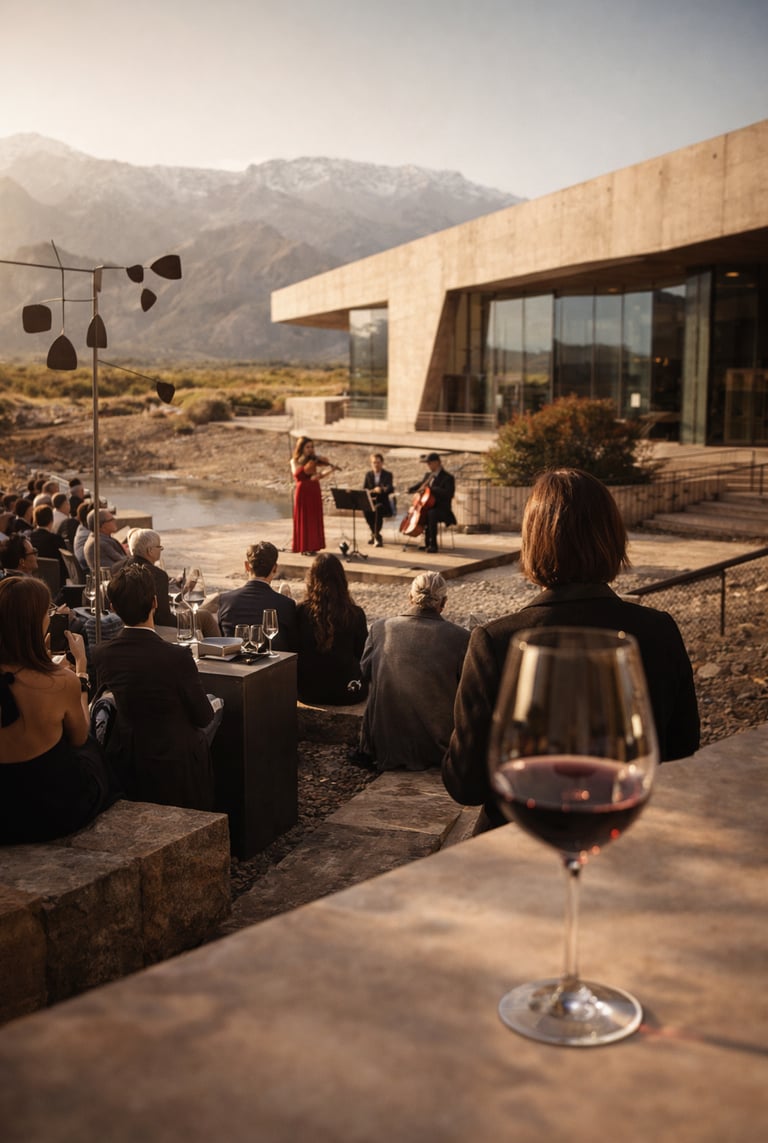
Activities with symbolic content. Intimate recitals, film cycles, workshops, art exhibitions.
Narratives that connect wine with thought. Philosophy, history, links with writers, scientists, artists.
Hospitality with purpose. It is not only about serving well, but about creating memorable atmospheres.
Piedra Infinita – Zuccardi Valle de Uco: geology, landscape, culinary art, identity-driven architecture. An experience where wine is contextualised within a territorial and emotional narrative.
Strategic Benefits of Positioning as a Cultural Actor
Greater emotional recall
A more sensitive, reflective, and loyal audience
Differentiation from wineries that only offer technical tours
Opportunities for alliances with institutions, artists, and cultural media
Bodegas Ysios (Spain): Calatrava architecture, artistic integration, sober and aesthetic discourse. Its architectural image is already part of the cultural imagination of wine.
Mistakes to Avoid When Integrating Culture into the Wine Tourism Experience
Layering art without symbolic coherence
Programming events without curation or purpose
Disconnecting the aesthetic experience from the product
Forcing a “cultured” discourse without narrative foundation
A winery does not become a cultural space by hanging paintings. It requires an integrated, sensitive, and sustained narrative.
How to Design a Winery That Transcends the Oenological
Define a long-term curatorial vision What kind of culture do you want to convey?
Build alliances with aligned figures Artists, architects, academics, musicians, writers. Not for fame, but for aesthetic and ethical coherence.
Activate content that connects with the visitor both emotionally and intellectually Not everything needs to be massive. Exclusivity also moves.
Reinforce that narrative at every touchpoint The glass, the music, the website, the guest book, the tone of the guide.
Conclusion: A Winery That Thinks as a Cultural Space Moves Beyond Wine
Because when the visitor feels they have lived something they cannot easily describe, wine ceases to be a product and becomes a symbol.
🍷 And in the world of luxury, that is what remains.
