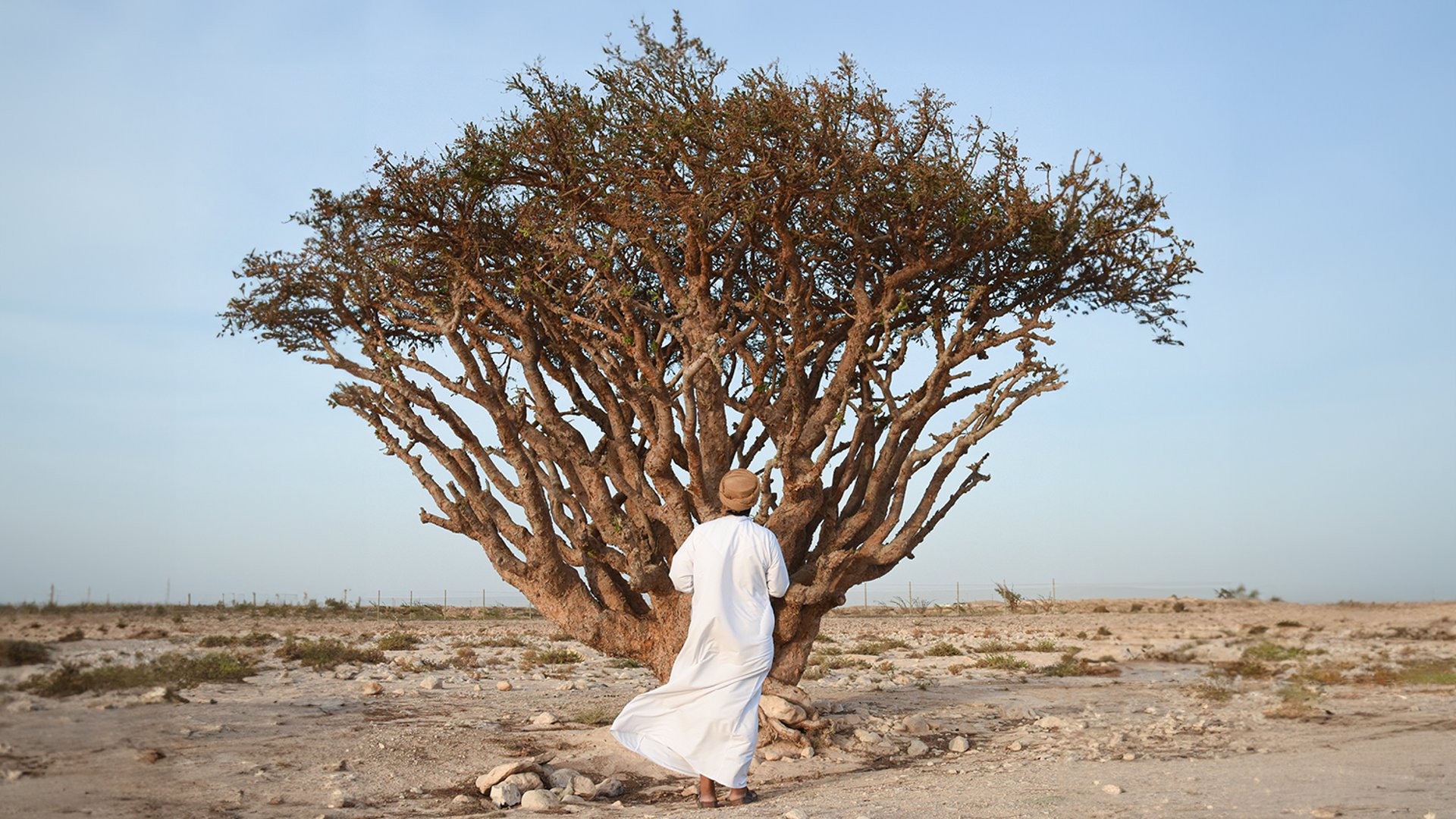
The tree that cannot be copied
Frankincense, Oman and traceability as a form of respect
SCENT AND STORY
5/5/2026
In Rome, merchants adulterated incense with pine resin. We know this because texts from the period describe experts who distinguished genuine frankincense by its appearance and texture — there was a counterfeit market so sophisticated that specialised vocabulary existed to describe it. Two thousand years later, the structural problem remains the same: in the global perfumery market, most frankincense arrives without a name, without a tree, without verifiable history. It arrives as a commodity. And a commodity, by definition, cannot sustain luxury.
That is precisely what the Wadi Doka project is attempting to reverse. And what I witnessed in Paris during Perfume Week convinced me that this is not merely an ethical sourcing project — it is one of the most compelling arguments I have encountered for how real differentiation is built in contemporary luxury.
Amouage presented its frankincense panel — “From Sacred Resin to Modern Perfumery” — with Matt Wright as project director, historian Valentina as the cultural voice, and Jean-Michel Potterot of DSM Firmenich as technical partner. Three perspectives on the same ingredient. What emerged from that conversation was not a product presentation. It was a demonstration of what it means to build differentiation from invisible structure.
The first expression that stopped me was smart forest. Matt Wright explained that every tree in Wadi Doka is measured, registered, mapped. Not as an abstract scientific exercise, but as an act of concrete responsibility: if you are going to use an ingredient, you must know where it comes from. From which tree. Under what conditions it was harvested. By whom. Under what remuneration.
It is an idea that sounds simple. In an industry where the incense supply chain may pass through four countries and countless intermediaries before reaching the laboratory of a perfumer in Grasse, it is radical.
Valentina raised a question that cuts across the entire conversation about luxury and origin: when we say something is sacred, what exactly are we talking about?
Frankincense has been described as sacred for millennia. But that sacredness, she explained, is historically contingent. In the Arabian Peninsula, it was part of everyday life — present at births, in schools, consumed as infusions, burned in homes. The sacred and the ordinary coexisted without contradiction. It was in Europe, after Christianity, where rarity and cost transformed frankincense into an exclusively religious object — and where that association crystallised into what remains today.
This distinction matters strategically. Because when a luxury brand invokes Omani frankincense, it is activating a symbolic charge largely constructed far from Oman. The challenge — and the opportunity — is to return the narrative to its true origin. Not as a gesture of marketing authenticity. As a value-building decision that marketing narrative may accompany, but never replace.
Jean-Michel Potterot clarified something with direct consequences for how differentiation in this ingredient is built — and sold: Boswellia sacra and Boswellia carterii, the two species often cited as distinct and which frequently justify differences in price and positioning, are taxonomically the same species according to genetic data from Kew Gardens.
The differences in olfactory profile that perfumers perceive — and which are real and significant — do not come from the species. They come from terroir: altitude, water stress, harvesting practices, the number of incisions in the bark and the interval between them.
For someone working in wine, this is immediately recognisable. It is exactly the same logic as Pinot Noir in Burgundy versus California — the same grape, radically different profiles because terroir creates conditions that cannot be transplanted. What makes Omani frankincense from Dhofar what it is is not botanical nomenclature. It is the specific conditions of a place, a microclimate, a harvesting practice accumulated over generations.
That is what makes origin genuinely inimitable. And that is what collapses any differentiation built solely on labels — replacing it with something far more solid: the difference comes from ethical and technical decisions, not nomenclature.
The Wadi Doka project also carries a social dimension inseparable from its value proposition — and one that illustrates one of the principles that interests me most in the construction of structural luxury.
Two generations of Omani harvesters abandoned the tradition. The elders retained the knowledge, but the work was not economically viable for younger generations. The result was a generational gap in a technique that takes years to master — precisely the kind of accumulated knowledge that exists in no catalogue and cannot simply be acquired, only inherited or rebuilt with time and intention.
The project transfers that knowledge to young people through formal employment and certified remuneration. Not as an act of charity — as a business model. Traceability requires people who know each tree. The people who know each tree require continuity and dignified remuneration. Dignified remuneration requires the market to pay for verifiable origin.
It is a virtuous circle that only functions if all parties sustain it. And that is precisely the point where most luxury supply chains break down — in the market’s willingness to pay for what cannot be seen.
The Ain Doka museum-distillery the project is building at the UNESCO site of Wadi Dawkah will become the physical expression of all this. Visitors walking through the valley, meeting the harvesters, touching the trees, following the resin from incision to essential oil.
I imagine that journey with the same logic through which I think about visiting an ageing cellar: you do not go to see a finished product, you go to understand a system. The time the resin needs to crystallise. The scent of the living tree before incision — somewhere between green pine and dried honey, with a minerality the essential oil no longer holds in quite the same way. The hand of the harvester who knows exactly how deep to cut without damaging the bark. The glass still designed by DSM Firmenich to operate daily inside the museum is not a decorative object. It is a statement: the process has nothing to hide.
There is something I learned while working with wine brands that applies precisely to what I saw in Paris: differentiation that withstands time is not found in the product itself. It lies in everything that preceded the product — the system of decisions, the accumulated knowledge, the relationships with territory and with the people who work it — which produce that product as a consequence.
A synthetic accord may approximate the olfactory profile of Omani frankincense from Dhofar. It cannot approximate the specific tree in that specific wadi, harvested by someone who learned the technique from his grandfather and now teaches it to a young person with formal employment and certified remuneration.
Aesthetics can be imitated. Origin cannot.
In Rome they adulterated incense with pine resin because the market lacked the tools to verify what was inside. Today those tools exist. The Wadi Doka project is building and using them. The question left for the industry is not technical — it is one of willingness. Whether it is prepared to pay for the invisible structure that sustains everything that can be seen.
When was the last time you were able to trace the true origin of something you call luxury — a perfume, a wine, an ingredient? And what changed in your perception when you did?
This chronicle forms part of the material shaping Diario de Nariz Vol. IV — a journey through the world of niche and ultra-niche perfumery: Paris Perfume Week, Niche Show London, Grasse Perfume Week and the perfumeries that preserve the soul of the craft.
Photographs: Amouage panel at Paris Perfume Week by NEZ · Screen from the talk “Frankincense — From Sacred Resin to Modern Perfumery” · Render of the Wadi Dawkah project, Dhofar, Oman · Amouage Outlands on travertine.
María Laura Ortiz Chiavetta — Aroma Storyteller
Winelux Scent & Story