The silent resistance
Three houses betting on what does not shout — and why that matters now
SCENT AND STORY
5/3/2026
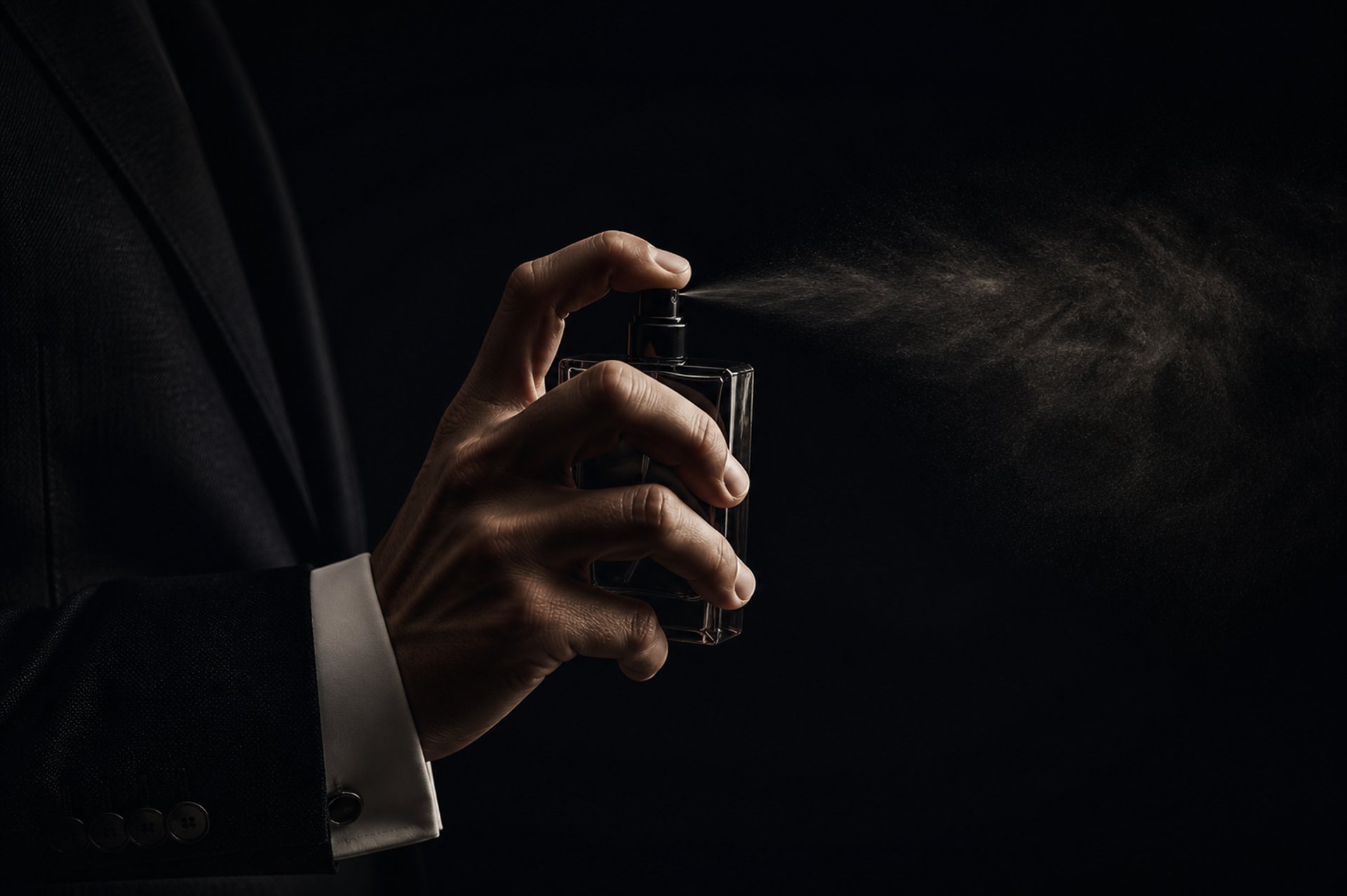
In the Paris métro, everything smells of the same accord. In Bangkok taxis as well. In Madrid airport, in the corridors of Dubai hotels, in the elevators of corporate buildings in São Paulo — the same accord, omnipresent, democratic and heavy. Ambrox in industrial doses, maximum projection, a presence leaving no space for anything else.
That is the background noise of massified luxury: fragrance as a declaration of volume, as occupation of space, as affirmation of existence through sensory saturation. And it is also, paradoxically, the clearest sign that something in luxury differentiation has broken — because when everyone shouts the same thing, nobody stands apart.
In the world of wine, I know this tension well. The high Parker-point wines, those seeking the approval of international guides through powerful structure and concentrated fruit, eventually began resembling one another regardless of origin. Terroir disappeared behind technique. Identity yielded to immediate accessibility. And it was precisely at that moment that independent producer wines — those prioritising expression of place over universal approval — began finding their most loyal audience.
During Paris Perfume Week I encountered three houses doing something analogous in perfumery. Not as a declared strategy — as a conviction about what luxury is and what a fragrance should do when it reaches someone’s skin.
Before entering into each one: what all three share is not a common aesthetic, nor a geography of inspiration, nor a similar production scale. What they share is a structural decision — building from the specificity of cultural reference, from honesty towards materials, from relationship with origin. That is exactly what imitation cannot reach: not the olfactory accord itself but everything preceding the accord and unavailable in any catalogue.
MEZEL Paris: Ritual as Architecture
The first time I saw the MEZEL Paris stand, I did not see it. I walked past because it did not shout. There was no dramatic lighting, no packaging competing for visual attention. There was a golden tray with five transparent glass bottles, minimalist black caps, and cards on pale wood with dense text assuming a reader willing to read.
I went back.
MEZEL is a Franco-Moroccan house working with specific Moroccan cultural rituals and translating them into fine perfumery without exoticising or simplifying them. The five fragrances are refillable — the refill format as commitment to continuity, not as sustainable marketing gesture. And each bears the name of something concrete: Cuir de Pastèque, Néroli Cuivré, Datte Opaline, Menthe Enivrante, Café Défendu.
Those names are not marketing poetry. They are exact coordinates.
Cuir de Pastèque — watermelon transformed into leather. Mathilde Bijaoui took the most iconic fruit of Moroccan summer and anchored it in Moroccan iris and a signature musk accord transforming it into something completely unexpected. I smelled it and needed a moment to recognise it: there is fruit freshness at the opening, something aqueous and clean, and then the iris elevates and grounds it. It is not watermelon with leather. It is watermelon becoming leather while you wear it. A transformation in real time upon the skin.
Café Défendu was the other fragrance that held me longer. Jérôme di Marino imagined a clandestine café in Tangier — cannabis accord, incense, coffee beans, vetiver, musk. Dense, dark, with a roundness coffee alone does not possess. It smells of a conversation that should not be happening, of smoke blending with something sweet and something bitter. It is not a fragrance that explains — it is a fragrance that situates. And remaining in that place feels like privilege.
What interests me about MEZEL as a proposition is that each fragrance possesses a precise coordinate — a ritual, a place, a specific cultural moment — and that precision is perceptible in the formula. There is no aromatic vagueness. There is narrative exactitude translated into chemistry. And that exactitude is precisely what the dupe cannot copy: not the accord itself but the decision to seek it there, in that specific place within Moroccan culture.
Anatole Lebreton: Material as Argument
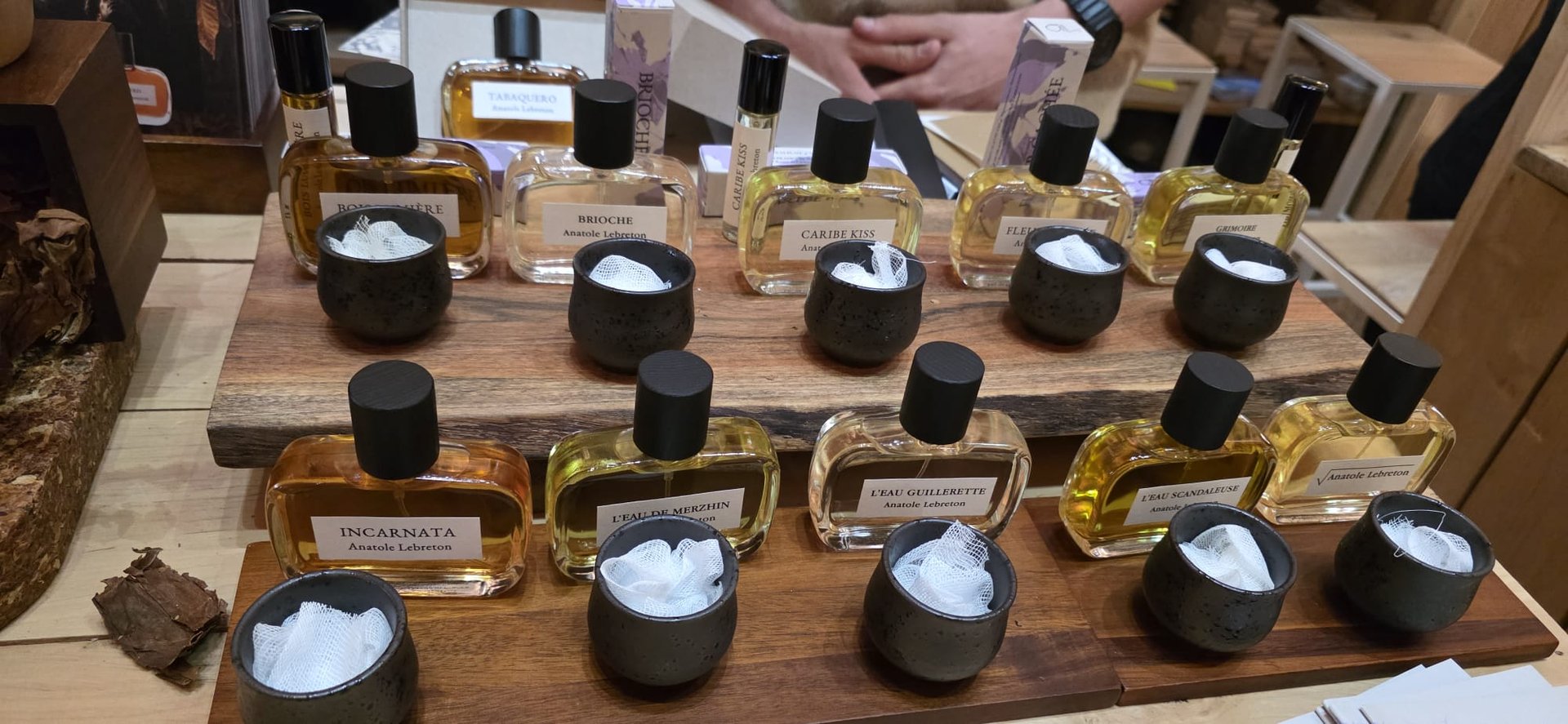
The Anatole Lebreton stand operated with the same logic of not shouting but with a radically different staging — not minimal but honest.
Tabaquero was presented upon real dried tobacco leaves, with a terracotta amphora and blotters arranged in a fan. The amber bottle rested on a bed of vegetal material literally constituting the central ingredient of the fragrance. Not an evocation of tobacco — real tobacco, physically present within the space.
I smelled it. There is something in Tabaquero conventional perfumery tobaccos rarely achieve: it is cured tobacco, not sweet tobacco. It possesses the dry roughness of real leaves, a controlled bitterness in the opening softening during development without disappearing. Beneath it, something warm and resinous anchors it without muting it. It is a perfume demanding attention — not because it is difficult but because it does not come towards you. You must go towards it.
That presentation decision — physical raw material as the centre of the display — is an epistemological statement: the fragrance comes from this. Not from a fantasy about this. From this.
In a market where packaging invents worlds bearing no necessary relationship to what lies inside, placing raw material at the centre is a gesture of responsibility so rare it becomes almost subversive.
The entire collection carries that same coherence. Uniform bottles, names telling something, a human scale not attempting to impress before you smell. Anatole Lebreton is an independent perfumer — no approval committee, no marketing brief preceding creation. The freedom this implies is not invisible in the result. It is there, in the specificity of each fragrance, in the willingness to move towards aromatic territories a corporate brief would have moderated before reaching the laboratory.
Jacqueline: Serendipity as Method
The third house did not have its own stand in the main hall. I found it in one of those encounters occurring at the margins of major events and sometimes containing more information than the keynote conferences.
Jacqueline creates through serendipity. She said it with precision: “ideas arrive before I look for them.” It is not mysticism — it is a description of process. The method is not searching for an idea and developing it. It is being sufficiently attentive to the world to recognise the idea when it appears, and then possessing the craft to translate it into fragrance.
Shaddam was born from a journey to the Himalayas, Bhutan, China and Sri Lanka in search of the origin of Nepalese sandalwood. Not as sourcing exercise — as source investigation. Wanting to understand where a material comes from before using it. I smelled it: there is something in that sandalwood catalogue sandalwoods do not possess, a slightly cool minerality beneath the usual creaminess. Like sandalwood remembering the altitude where it grew.
Flower of Scotland emerged from a specific cultural detail: the Scottish tradition of placing a drop of whisky into the clear water of a flower bouquet to prolong its life. That drop, Jacqueline explained, changes something in how the flowers smell — producing an interaction between the alcohol of the spirit and the aromatic compounds of the stems generating something existing in neither separately. Again co-distillation. Again emergence. Again the accord appearing at the intersection of two materials nobody had combined in that way before.
What interests me about Jacqueline is not serendipity as concept but what it implies as practice: being in the world with sufficient attention and sufficient technical knowledge to recognise a fragrance appearing within a Scottish tradition or a spice market in Kathmandu. That combination — curiosity plus craft — is precisely what no algorithm can replace and no brief can generate.
These three houses do not share aesthetic, geography or scale. What they share is something more difficult to name and easier to recognise: a relationship with raw material and process preceding any market consideration.
They are not asking what the market wants and building towards it. They are asking what this material, this ritual, this specific cultural moment has to say — and trusting that if the translation is honest and precise, someone will be willing to listen.
That trust is, ultimately, the most exact definition of silent luxury in perfumery. Not absence of projection but the conviction that projection must be earned through result, not imposed through volume.
There is a broader context that should not be ignored. The global fragrance market faces two simultaneous pressures moving in opposite directions. On one side, dupe culture — pushing established brands to justify their price through something imitation cannot provide. On the other, aesthetic homogenisation — making it increasingly difficult to distinguish between propositions that should be distinct.
Within that context, silent luxury is not merely an aesthetic position. It is the most robust differentiation strategy available. Because what does not shout is, paradoxically, the hardest thing to copy: the specificity of cultural reference, the precision of translation, the relationship with a material coming from a concrete place and from a concrete decision to seek it there.
A dupe may reproduce the accord of Cuir de Pastèque. It cannot reproduce Mathilde Bijaoui’s decision to anchor Moroccan watermelon in iris before anyone asked her to do so. It cannot reproduce the real tobacco leaves upon which Tabaquero rests. It cannot reproduce Jacqueline’s journey to the Himalayas searching for the origin of a material because she needed to understand where it came from before using it.
That layer — invisible in the bottle, present in the result — is what the fine perfumery market should be building more of and communicating better.
At the end of the week, walking between stands and conferences, I arrived at a conclusion I did not possess when I arrived in Paris.
Olfactory luxury is not endangered because dupes exist. It is endangered when the brands that should be inimitable become so noisy and so homogeneous that the dupe appears to be a reasonable alternative.
The houses I encountered within silent luxury — MEZEL with its precise ritual, Lebreton with its honest materiality, Jacqueline with her serendipity transformed into method — are not responding to that danger. They are ignoring it elegantly and building from an entirely different place.
And that is, ultimately, the only response with a future: not competing on the terrain where homogenisation has already won, but occupying the territory where specificity renders comparison irrelevant.
Luxury that does not shout does not need to defend itself from noise. It only needs to find the listener capable of hearing in silence.
Is there a fragrance — or a wine, or anything you call luxury — that asked for your attention instead of offering itself immediately? And what did you find when you stopped to listen?
This chronicle forms part of the material shaping Diario de Nariz Vol. IV — a journey through the universe of niche and ultra-niche perfumery: Paris Perfume Week, Niche Show London, Grasse Perfume Week, and the perfumeries preserving the soul of the craft.
Photographs: MEZEL Paris — complete stand with descriptive cards for the five fragrances · Anatole Lebreton — Tabaquero upon dried tobacco leaves with terracotta amphora · NISSABA Fragrances from Earth — founders at the Racyne hall stand.
María Laura Ortiz Chiavetta — Aroma Storyteller
Winelux Scent & Story