The Perfume as Heritage
When a Family Story Becomes a Fragrance
SCENT AND STORY
5/12/2026
By María Laura Ortiz Chiavetta — Aroma Storyteller, Winelux Scent & Story
There is something no perfumery book teaches you: behind the finest bottles, there are no formulas. There are families.
I realised this clearly in London, during two days that had not been planned in the same way, yet ultimately answered the same question: what turns a fragrance into something that transcends smell? The first was an afternoon at Les Senteurs in Belgravia — one of London's oldest niche perfumeries, owned by the Hoxley family and established in 1984. The second was the Niche Show, where more than one hundred emerging brands presented their collections to buyers, journalists and curious visitors like myself, searching for the final three perfumes I needed to complete my book.
In both places, I found the same thing, although in opposite formats: perfume understood not as a product, but as transmission. As something inherited, reconstructed and passed on.
Portugal, a Coal Mine and the Jasmine of Grasse
The first story that stopped me was Sora Dora's.
A Portuguese great-grandfather decides to leave his homeland. Not for adventure — out of necessity. He arrives in France searching for work, any work, and ends up in a coal mine. It is exhausting labour, far removed from everything he knew as a farmer. Yet chance — or perhaps something greater than chance — moves him elsewhere. He eventually reaches Grasse, the olfactory capital of the world, harvesting jasmine.
A man who was once a miner and ended up among flowers.
That image stayed with me. Not as a metaphor, but as a fact: a body that moved from coal to jasmine, from darkness to one of the most delicate aromas in existence. And that transition was not only personal. It was generational. He passed that passion to his goddaughter, who passed it to her mother, who passed it to her son. Four generations of a family built upon scent as a language.
Today, Sora Dora is an artistic fragrance house that treats this heritage as a raw material. Not as decorative nostalgia, but as both a technical and emotional starting point. Its fragrances seek transformation on the skin, revealing nuances that were not expected and finding the unusual within the real.
What struck me most about this story was not its romanticism. It was the precision of its genealogy. Four generations are enough time for something to become destiny.
Iceland, a Shipyard and the Smell of a Father's Work
Fischersund reached me through its numbers.
They do not have fragrance names. They have numbers. 27. 54. 8 At first, that aesthetic decision struck me as conceptual. Later, I understood that it was literal: the numbers refer to specific memories, not generic atmospheres.
They are four Icelandic siblings. One of them is a musician from Sigur Rós. They began creating perfumes in 2017, when the musician brother started exploring fragrance without formal training, approaching it with the same logic he applies to musical composition: intuitively, through sensory memory.
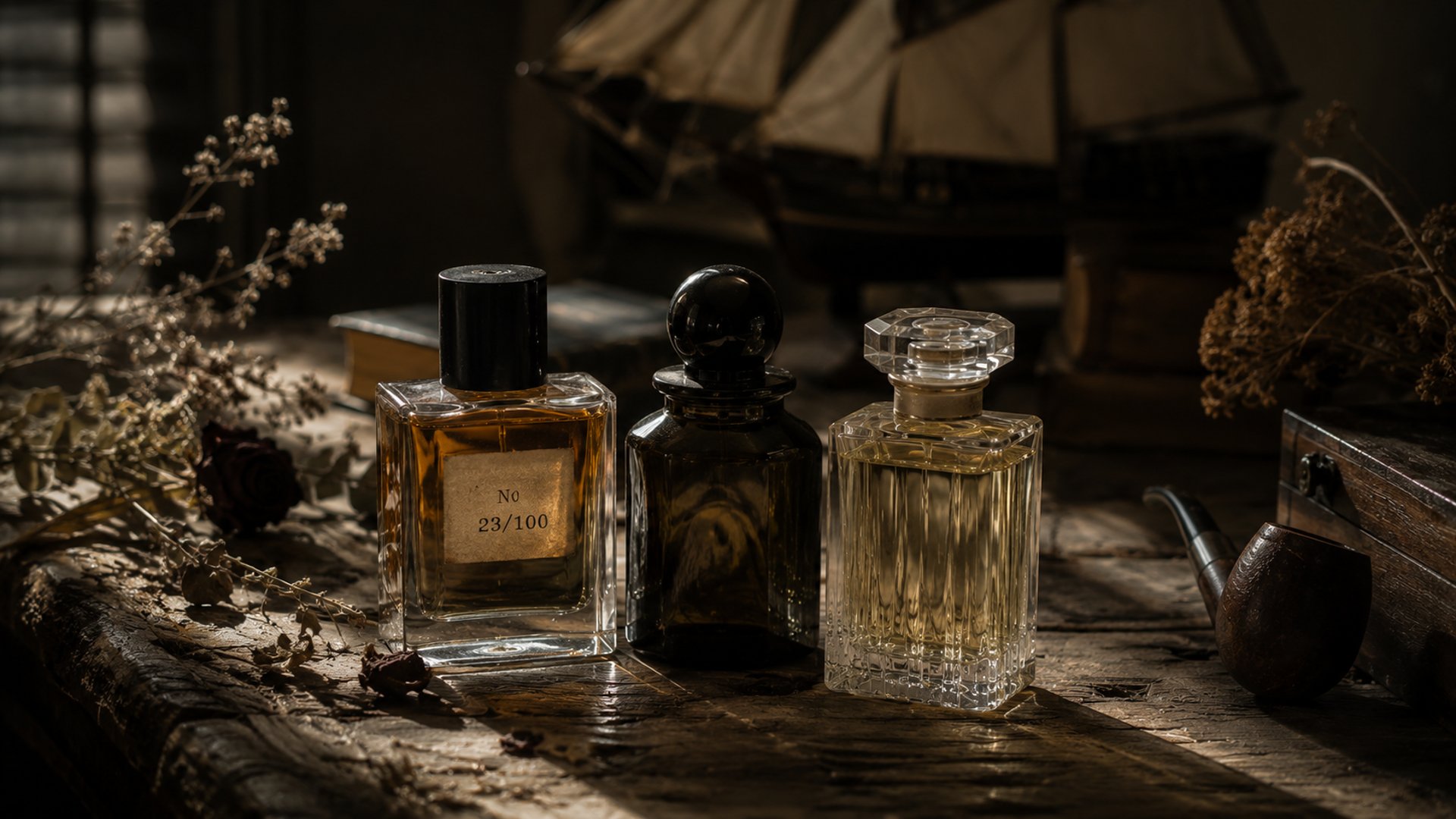
Number 27 emerged from something very specific. The memory of the harbour shipyard where their father worked. The salinity of the sea striking the hulls of ships. Engine oil. The tobacco pipe their father smoked. It is not a fragrance about the sea in the abstract. It is an olfactory portrait of a man in a specific place, at a specific moment in time, doing a specific job.
Number 54 takes that logic even further. Their father's metal workshop. Ammonia. Petrol. Varnish on wood. The smells a child would not normally be close enough to inhale, yet which become part of one's most intimate memory when they are the smells of the adult one loves most.
What Fischersund does is extraordinary because it does not romanticise. It says: my father smelled like this, this is what I have of him, and I want to preserve it exactly as it was. There is a radical honesty in that gesture, one that rarely appears in luxury perfumery.
To complete the experience, poems read by Lilia — in Icelandic and English — are available as audio recordings on their website. The perfume becomes multimedia, and the memory of the father becomes collective.
Atlanta, a Sister and Juicy Couture's Pretty in Purple
The story of Elysian Parfum was the one I found hardest to hear without my voice breaking.
Jessi Park founded the brand in 2021. Its name combines the names of her sister's children — Elysia and Evan — and also means "from heaven" in Greek. It is not a casual play on words. It is an epitaph that chose to become a brand.
Her sister died of cancer after a long and painful battle. During that time, what connected them was perfume. Not as a topic of conversation — as a shared experience. They smelled fragrances together. They commented on them, remembered, transported themselves. Perfume as a way of being present when the body can no longer be fully present.
Her sister's favourite fragrance was Pretty in Purple by Juicy Couture. A mass-market perfume, accessible, far removed from the niche universe. But Jessi does not mention it with embarrassment. She mentions it as an origin. Because what her sister loved was not the formula — it was how she felt when wearing it. And that is exactly what Jessi tries to capture in each of her fragrances: not notes, but states of being.
After her sister died, Jessi began blending fragrances. Not as a commercial project — as grief. As a way of remaining connected to someone who was no longer there. Each bottle is, in that sense, a postponed conversation.
Today, Elysian is a completely artisanal company. Her husband Milot and daughter Jorian participate in packaging and shipping. Everything is handmade in Atlanta. Last year, they won the award for Best New Fragrance of 2024 with Lavender Milk Tea — lavender, creamy milk, black tea and a whisper of tuberose. A hug in a bottle.
The fragrance that spoke most strongly to me that day was Temple of Echo. A dark, damp forest. Incense. Wet stone. Burnt wood. Then, gradually: milk caramel, saffron and rose. It is a fragrance that begins in grief and ends somewhere close to peace.
What They Have in Common
Three brands. Three continents. Three stories radically different in form and deeply similar in impulse.
In all three cases, the perfume was born from something that cannot be chosen: a great-grandfather's migration, a father's profession, a sister's death. No one decided to make perfume as a pure aesthetic exercise. They all began from an older need — to preserve, to honour, to continue.
That completely changes the relationship one has with the bottle.
When you buy a perfume from one of these brands, you are not buying a fragrance. You are entering a story that someone built in order not to lose something. And that — that density of meaning behind the glass — is exactly what mass perfumery cannot replicate, no matter how much marketing budget it has.
Niche perfumery, at its best, is not a price category. It is a way of making things that implies that someone put something irreplaceable inside.
A Personal Note
For years, I have travelled with my sense of smell as a compass. I have been to 195 cities, and in many of them, what I remember best is not an image but a scent. The orange blossom of Seville. The leather of Florence. The dampness of the Paris Métro.
When I sit across from someone who tells me how a family story became a fragrance, I understand that we are speaking the same language from different angles. I narrate aromas. They distil them.
What I found in London — in Belgravia and at the Niche Show — was the confirmation of something I have maintained ever since I began writing about perfumery: the best perfumes are not formulated. They are inherited.
And inheritance, unlike fashion, does not expire.
María Laura Ortiz Chiavetta is the founder of Winelux Scent & Story and the author of Diario de Nariz, a four-volume series on olfactory storytelling and synesthetic fragrance analysis. She writes at the intersection of wine, luxury, and sensory culture.