The luxury that invites
A visit to Tiffany & Co. in London, and what the pieces say before anyone speaks
5/3/2026
There is a fundamental difference between a luxury that selects you and a luxury that receives you.
In the previous article of this series, I wrote about Graff — a world where value is not explained because it is assumed that whoever arrives already carries the frame of reference to perceive it. A world that turns the piece over before showing it, that polishes surfaces no one will ever see, that produces one hundred unique rings per month without repeating any. A world that recognises, rather than invites.
Tiffany & Co. is another conversation. Equally legitimate. Equally sophisticated. But in a different language.
Entering
The Bond Street store has something that very few jewellery houses achieve: making entry feel like a correct decision, not a test to pass.
There is no evaluative coldness. No silence designed to intimidate. There is light — warm, calculated — and a cadence of attention that activates before one has even settled in. The advisor who received me knew exactly what to show. Not because I had asked, but because he had observed. That kind of reading — silent, precise — is a form of intelligence that in the wine world we would call sommellerie: the ability to read someone before recommending.
What Tiffany does better than almost anyone is this: belonging is not earned. It is activated.
Schlumberger: the designer who did not want symmetry
The visit revolved around two collections. The first was Schlumberger — Jean Schlumberger, the Franco-Alsatian designer who worked with Tiffany for decades and whose influence remains, today, one of the house’s most recognisable creative axes.
The first thing the advisor explained about Schlumberger was what interested me most: he did not like symmetry.
“He liked things a little bit uneven. He didn’t like things to be all symmetric together. So he makes it more alive.”
I looked at the pieces with that in mind, and the difference became immediately visible. The bird brooches — two birds in flight, covered in white diamonds with yellow gold details — have an intentional asymmetry that makes them vibrate. They are not still. There is tension in the wings, movement captured in metal and stone. The Starburst brooch, a sphere of pavé diamonds with gold projections radiating outward, has the same energy — it is not decorative jewelry, it is almost kinetic.
I thought of the wines that interest me most: those that have something slightly out of place, an unexpected acidity, a texture that does not resolve entirely clean. Technically perfect wines are admirable. Those with their own character are the ones that remain.
Schlumberger understood this. His pieces have character before perfection.
What the photograph does not capture
There was a moment during the visit that defined everything.
The advisor placed the Wings collection bangle on the display — in platinum and gold, fully pavé-set with diamonds, with a feather motif along the edges. I picked it up carefully.
“The pictures didn’t take the beauty,” I said. “You can see the picture, but it’s not the same to see here.”
“They can’t feel it, they can’t touch it,” he replied, referring to his own clients who sometimes try to choose through photographs.
And he was right. What the photograph does not convey is texture. The bangle has a weight that is perfectly distributed — not heavy, not light, but balanced, as if it had been calculated so that the arm forgets it while wearing it. The surface has a softness that contradicts its complexity: each diamond is set in a way that eliminates any perceptible edge to the touch. On the outside, light. On the inside, silk.
“Strong and smooth,” I said. “Exactly,” he replied.
And then I added what I was still thinking aloud: “It transmits something powerful but so soft at the same time. It’s not show off.”
“Not too powerful, but not too over,” he confirmed.
That phrase — not show off — is perhaps the most honest definition of luxury I heard throughout the entire trip. It is not the absence of ambition. It is control over how that ambition manifests. It is exactly what distinguishes a great wine from a wine that works too hard to impress: one convinces because it exists; the other convinces because it insists.
Apollo and the scale of desire
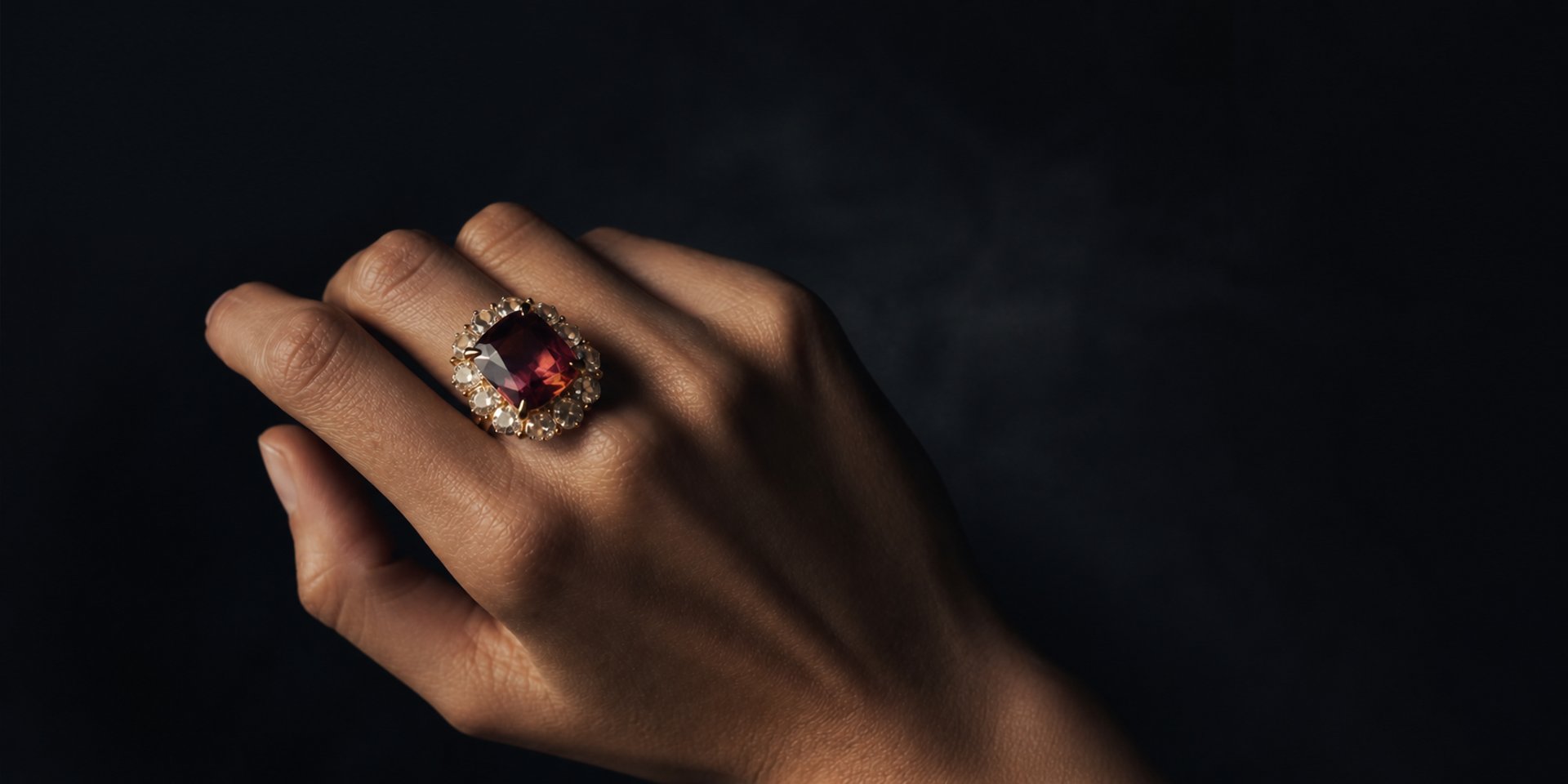
The second collection the advisor chose to show me was Apollo — a ring with a central diamond surrounded by smaller stones that decrease towards the edges, creating a halo effect that does not rely on size but on proportion.
“More wearable for all kinds of occasions,” he explained. “Daily use, special events — it works for both.”
What Apollo illustrates is something Tiffany handles with an intelligence that very few luxury houses have resolved so well: the scale of desire. There is a continuity of language throughout the entire collection — the same motifs, the same philosophy, the same level of detail — that allows both a first-time visitor and someone who has been collecting for twenty years to find something that belongs to them.
That is not the democratisation of luxury. It is the architecture of desire. There is a difference.
In the world of wine, we recognise this in houses that have entry points at different price levels without losing coherence of identity. The consumer who today buys an accessible bottle is, consciously or not, in the same universe as the one who buys the grand reserve. The door is open at different points, but the house is the same.
What Tiffany protects
At the end of the visit, the advisor mentioned the Bubok event in New York — Tiffany’s annual high jewelry presentation, with unique pieces and a waiting list built months in advance.
“All of the Bubok pieces are one of a kind,” he said.
There lies the bridge with Graff that is not immediately visible. Tiffany has a public face — the blue, the name, the myth — and a less visible face: high jewelry that operates under the same logic of rarity and uniqueness that defines the most discreet houses in the sector. The difference is that Tiffany does not choose between the two. It sustains them simultaneously, with a coherence that takes decades to build without breaking.
That too is a form of value that time makes visible — or dismantles, when it is not well constructed.
Two languages, one question
I left Tiffany with something I had not anticipated: not only impression, but belonging. The feeling of having been in a universe that knows how to make someone feel exactly in the right place.
It is different from what I felt leaving Graff — that stillness of having been close to something that exists beyond the usual categories of luxury.
Neither is superior. They are two different answers to the same question: what is beauty for?
Graff answers: to exist truthfully, regardless of who perceives it.
Tiffany answers: to create the moment in which someone recognises that something belongs to them.
In wine, both answers have a name. Great single-parcel Burgundies are Graff’s answer. Champagne in a celebration is Tiffany’s answer. Neither replaces the other. Both are necessary because they respond to different needs of the same desire: that something valuable endures.
And in that, jewelry and wine speak exactly the same language.
María Laura Ortiz is a strategic consultant in wine and luxury, founder of Winelux, author of The Luxury Pairing Method (2026), and Wine Voice for Wine-Searcher. She travels regularly to London, South Africa, Argentina and Spain, covering the intersection between wine and luxury in all its forms.
Next in the series — Article III: Graff, Paris. Value in Space.