

The Luxury of Slow Time
How to Position Without Rushing
5/28/2026
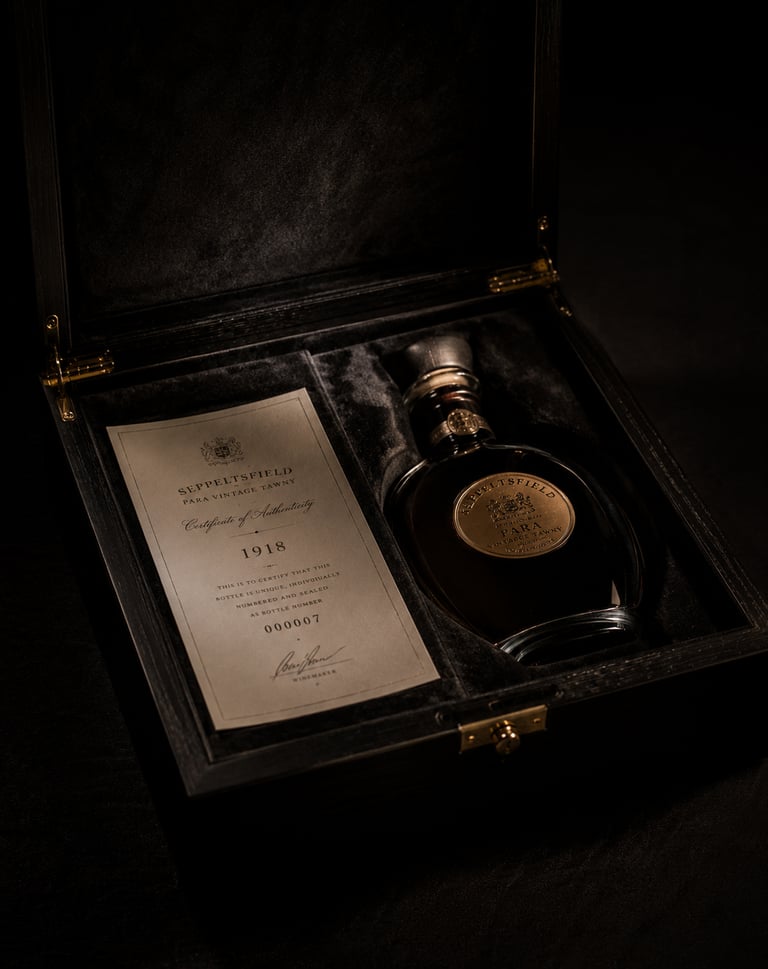
In Barossa Valley there is a winery that each year does only one thing: it releases a small quantity of wine that has spent one hundred years in barrel. No more than what corresponds. Not before the moment is right. In 2025, Seppeltsfield released its 1925 Para Vintage Tawny — an oval mini bottle, black box, numbered certificate, winemaker’s signature. An object that cannot be rushed because the time it contains is not recoverable. If the release happens earlier, the wine does not yet exist. If it happens later, something will have been lost forever.
That is the most honest argument I have found about time as symbolic value in wine: it is not a marketing decision. It is a condition of existence.
What Time Reveals — and What It Demands
At Schloss Johannisberg, in the Rheingau, director Stéphane Doctor showed us something very few wineries in the world can show: a collection beginning in 1801 — considered one of the oldest wine libraries in the world, with two or three bottles from every vintage preserved since then. They are not tasted. They are there as physical testimony that the right decisions, taken with patience and continuity over two centuries, leave behind something no marketing campaign can fabricate. What I did taste during that same visit were Rieslings from historic vintages that Stéphane Doctor selected for us — and which demonstrated, glass after glass, how far a wine can go when time has been respected.
The oldest wine I have ever tasted is another: an 1832 Madeira. But that is another story — and another article.
It is not that time automatically improves wines. Time amplifies what is already there. If the foundation is solid — the vineyard, the vinification, the decision to wait — time deepens it. If the foundation is weak, time exposes it. There is nowhere to hide in a bottle carrying two centuries of history.
That is what the luxury of slow time truly demands: not patience as a decorative virtue, but real confidence in what is being built. A brand that waits because it has no alternative is not the same as a brand that waits because it knows exactly what it is doing.
Living It Personally
For years I advised clients on launch timing, on the importance of not rushing, on the symbolic value of allowing a wine to find its moment. I knew it. I argued it well. But there is a difference between knowing something and living it with your own wine.
Andesine — my wine, pronounced andesín — is from the 2022 vintage. By the end of 2023 it was technically ready. I could have launched it then. The temptation existed — one wants to see the result of years of work out in the world, wants people to taste it, wants to know what they think.
I waited. Bottle time. Development. Communication built carefully. Strategy so that when someone opened it, they would find it at the best possible moment.
On 19 March 2026 — four years after the harvest — Andesine was launched in Madrid, during the Argentina–Spain bilateral export meeting. Four years from the vineyard to that table. And only then did I understand, in a way no client and no book had ever given me, what it means to trust time when it is your own work that is waiting.
1,150 Days Planting
Winelux Business Insider was born on 17 March 2023. Since then, at least one article every week. Without exception.
1,150 days have passed. And yes — sometimes the temptation appears to publish more, to be more present, to react to what is happening in the market. The logic of the algorithm constantly pushes in that direction. More frequency, more reach, more visibility.
But what I am building is not reach. It is sediment. The difference between a publication that is read today and forgotten tomorrow, and a body of work that someone, three years from now, will discover and read entirely, from beginning to end, because it has coherence, because it has a voice, because it was not written for the moment but to endure.
One article a week. 1,150 days. Without accelerating. That too is slow time. And it too is a positioning decision.
What Brands That Do Not Rush Have in Common
Seppeltsfield does not release Para Vintage when the market asks for it. It releases it when the wine turns one hundred years old — not one day earlier. Schloss Johannisberg does not redesign its visual identity to appear contemporary. It preserves bottles from 1801 because it understands that continuity is its most powerful argument. Andesine was not released when it was technically ready. It was released when everything surrounding it — the wine, the communication, the context — was aligned.
What these brands have in common is not slowness. It is direction. They know exactly where they are going, and that allows them not to run. Urgency is almost always a sign that something is not yet clear — the product, the positioning, the identity. Brands with clarity can wait. Those without it use speed to disguise the absence of clarity.
In fine wine, that difference can be read. Not always immediately — but it can be read.
