

The Brand as a Body
Movement, Tone and Presence in the World of Wine
5/21/2026
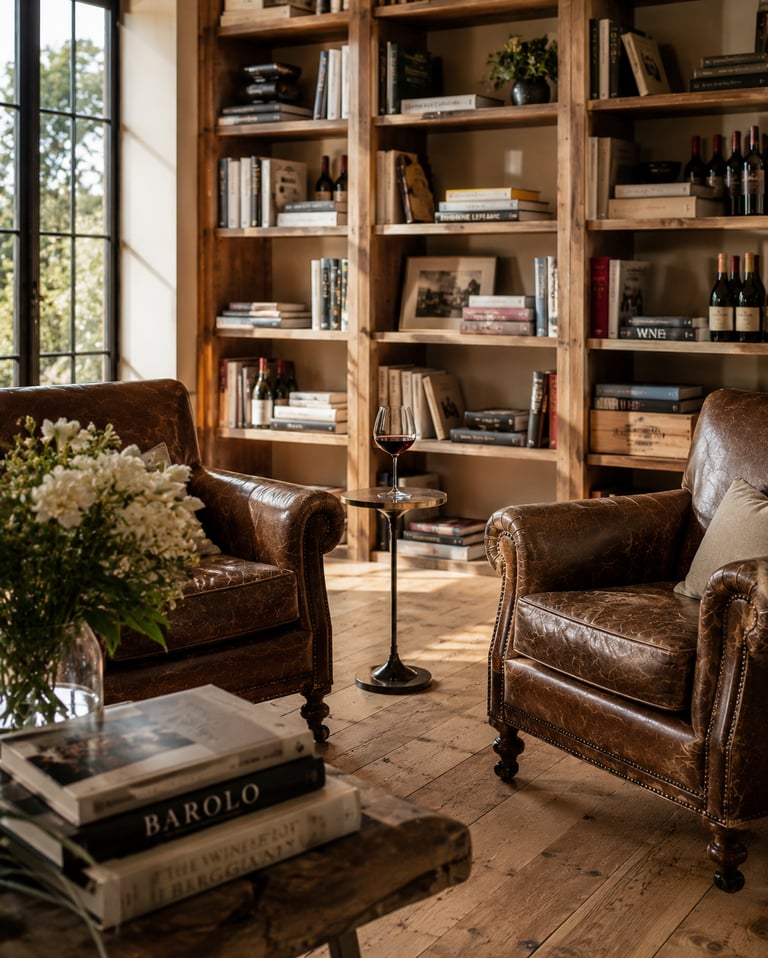
Eben Sadie welcomes you into his home. Not into a reception room, not into a space designed to impress. Into his home. Two leather armchairs. Books everywhere. Flowers — always flowers. And crystal glasses that one holds in the hand and already knows something is about to happen before the wine even reaches the nose.
There is no prepared speech. No script. There is a man who wants to show you something that matters deeply to him — the vineyard, the commitment of his team, the pursuit of something truly unique — and who trusts that if he shows it well, he does not need to explain it too much. He allows you to make your own interpretation. He allows you to arrive there on your own.
At one moment in the conversation, speaking about winery culture, he said something I never forgot: “If there's a brick lying there and you don't pick it up instantly, you're already in the wrong place because you don't understand this place.” He did not say it as management advice. He said it like someone describing a truth so obvious it is almost embarrassing to have to state it aloud. That is what happens when a person and their place are the same thing.
And later, walking down into the cellar, with that dryness he sometimes has: “If there's a lot of wood in a wine, you can't taste the vineyard. If you like wood, it's better to buy furniture.” Precision without ornament. The man and the wine, once again, saying the same thing.
That is presence. Not performance.
Three ways of occupying a space
In Margaret River, Bruce Dukes of Domaine Naturaliste came out to welcome us — a group of twelve people, a professional visit — with a smile and an outstretched hand. A warmth that made you feel as though you already knew him, as though the conversation had begun long before even if it was your first encounter. Afterwards, the tasting in a wood-and-glass space overlooking the vineyard. Simple. Without unnecessary ornament. And wines possessing a finesse, an elegance, a connection to the natural world that was exactly the same thing he himself transmitted. The man and the wine were coherent. One could read the other.
In Adelaide Hills, Michael Hill Smith — Master of Wine, co-founder of Shaw + Smith — carries a different presence. An almost architectural verticality. A seriousness that is not coldness but structure. A firmness in every gesture recalling a certain European tradition where discipline is not announced: it is simply there, embodied. And that same vertical line, that same uncompromising precision, can be read in his wines. The coherence is complete. Not because he calculated it, but because he is the same person in both places.
Two completely different models of authentic presence. Warmth in one, structure in the other. Yet both share something fundamental: neither is trying to communicate an image. They are being what they are, and that transfers effortlessly into the wine.
When presence becomes performance
I have also been in the opposite place.
Wineries where the person in front — owner, winemaker, brand ambassador — wants so badly to control the message that no space is left for the visitor to form their own opinion. Every silence is filled. Every question redirected. Every glass accompanied by the correct interpretation, the one you are supposed to take away with you. The result is paradoxical: the more insistently one tries to communicate, the less is actually transmitted. Because what reaches you is not the wine nor the winery — it is the effort to convince.
The sophisticated consumer detects this immediately. And what they detect is not necessarily falseness — sometimes it is simply anxiety. A brand that does not fully trust what it possesses, that needs to manage perception because it fears what might happen if it let perception move freely.
The difference between a brand that imposes and a brand that simply inhabits presence is exactly that: trust in the object itself. Eben Sadie does not need to tell you his wines are exceptional. He places a glass in your hand, in his home, among his books, and waits. The wine speaks. He does too — but afterwards, and from a place of equality, not from above.
The brand body beyond the individual
Sadie has another way of describing this when speaking about his team. During the conversation he asked me: “Is your green apple my green apple?” The question he asks the people working with him to verify that everyone is seeing the same thing, moving in the same direction, without anyone needing to push.
“When everybody's going in absolutely the same direction, it pushes itself forward.”
This is what, in strategy, we call the symbolic body of a brand: the sum of all the gestures, tones, rhythms and postures a brand adopts at every point of contact. Not only the packaging or the architecture — but how it answers the telephone, how it replies to an email, how it serves at a trade fair, how it trains its team to occupy space in the same way the founder occupies it.
When that body is coherent, the brand possesses real presence. When it is not — when the label says one thing, the space another, and the staff a third — the brand has no body. It has parts that do not recognise one another.
What cannot be hired
The authentic presence of a brand cannot be entirely delegated nor built from the outside inward. It can be refined, sharpened, made more conscious. But its origin must be real.
Bruce Dukes did not come out to welcome us warmly because someone told him warmth was a good hospitality strategy. He came out that way because that is who he is. Michael Hill Smith does not possess that verticality because he studied how to project authority. He possesses it because decades of discipline in the world of wine shaped him that way. Eben Sadie does not receive you in his home with leather armchairs and flowers because he read that intimacy generates emotional loyalty. He receives you that way because that is his home and that is his way of being in the world.
And when you ask him how he sustains that over time, with a team, with market pressure, with everything constantly changing around him, the answer is simple: “Sometimes the best thing you can do for your company is not come to work. Just get everybody on a bus, go sit somewhere, and make sure we're all still on the same page.”
A brand understanding this does not try to manufacture presence. It tries to recognise the presence it already has — and build from there, with coherence, with patience, with the confidence that authenticity does not need to be explained in order to be recognised.
