Six months in oak, six months in sandalwood
When time stops being a marketing value and becomes an ingredient
SCENT AND STORY
5/7/2026
There is a question this house asks before producing. It is not: is there demand? It is not: what is the launch date? It is: is it ready?
That question — apparently simple, structurally radical — is what distinguishes houses that treat time as a variable of convenience from those that treat it as a raw material. In perfumery, where launch speed has become a metric of relevance and where an entire collection can be created in the time other houses dedicate to a single maceration, choosing time as an ingredient is an almost political statement.
The collection that led me to think about this is called Essences. Its architecture is what in oenology we would call a double ageing system — except that here the vessels are not Bordeaux barrels but two materials chosen with surgical precision for what they have to say chemically and sensorially.
Before explaining how the system works, I want to tell you what it produces. Because in perfumery, as in wine, the process is better understood when you begin with the result.
What the double maturation produces is patina. Not projection — patina. That almost tactile quality, silky and dense at the same time, that makes the perfume feel complete rather than assembled. A base that does not sit on the skin but integrates with it, like fabric that has been washed many times and has found its definitive weight. It is the difference between a perfume that lasts and a perfume that matures.
The system works like this. The base alcohol — sugarcane bioethanol — matures for six months in medium-toast oak barrels. The logic is the same as in Cognac production: the alcohol acquires structure, roundness, a memory of the oak that is not aromatisation but transformation of the support itself. It is not about adding woody notes. It is about changing the nature of the vehicle that will carry the perfume.
Simultaneously — or sequentially, depending on the cycle — the perfume concentrate rests for six months on Australian sandalwood chips between 60 and 80 years old. Santalum spicatum and Santalum album from northern Australia, from desert regions. With occasional agitation and without haste. As the team said with a simplicity that contains the entire philosophy of the house: nature does the magic. There is no technical intervention that accelerates what the sandalwood has to give the concentrate over that period of time. Either you wait, or it does not happen.
After that double maturation, the two components are united. And then there is one additional week of post-unification maceration.
Six months plus six months plus one week. Twice a year. Without exceptions.
Australian sandalwood deserves its own paragraph because the decision to use it says as much about the house as the process itself.
It is not the Santalum album of Mysore that dominated classical perfumery and which today exists under protected extinction. It is sandalwood from the desert regions of northern Australia, harvested from trees between six and eight decades old. The house has a sourceur dedicated exclusively to this material — someone whose work is to know the territory, the seasons, the specific trees that produce the wood with the profile the process requires.
That figure says everything. Not a supplier selecting from catalogues. Someone who knows individual trees on a specific continent. It is exactly the difference between a winemaker who buys must and a viticulturist who knows every parcel of his vineyard — who knows which block produces which profile in which year and why, because he has spent decades observing it. The result in the glass, or in the bottle, reflects that difference even if nobody knows how to name it while smelling it.
The Omani rose is the other axis of this story, and it contains a complexity that I believe was the most honest insight I heard during the entire week in Paris.
The roses of Jebel Akhdar grow at 2,500 metres above sea level, on terraces irrigated by falaj systems — underground water channels classified by UNESCO as World Heritage. Harvest takes place between late March and early April. A window of only a few weeks. A territory that cannot be replicated.
But there is something the house discovered that requires courage to say out loud: the smoky Omani rose — that rosewater with barbecue-like notes that local families produce in clay pots over wood fire, culturally iconic and culinarily valuable — is technically unusable in fine perfumery. The pyrolysis that occurs when direct heat touches the petals generates compounds excluded by industry standards.
That means the most identity-defining element of the Omani rose — its smoky character, what makes it recognisable and emotional for those who grew up with it — is precisely what perfumery cannot directly use.
This tension between cultural value and technical viability is one of the most honest problems in origin-based luxury. Not everything authentic is directly usable. And the way a house navigates that tension — whether it hides it, simplifies it, or works through it with integrity — says everything about its real relationship with the territory it invokes.
The answer from this house is co-distillation: processing multiple ingredients together to create emergent profiles that do not exist in any of the individual components alone. The result does not replicate domestic smoky rose — it creates something new that carries memory of it without its technical limitations. A rose that remembers fire without being burned by it.
I think about the parallel with great age-worthy wine — not as analogy but through the concrete work with wineries that choose long ageing when the market does not demand it. A Barolo that needs fifteen years to open is not difficult — it is a wine that requires time to do what technique cannot. That waiting is not a flaw in the process. It is its most valuable result: the integration that only occurs when the components have had real time to meet each other.
In perfumery, that logic is even rarer. Most commercial fragrances macerate for days or weeks. The alcohol stabilises, the molecules settle, the perfume rests long enough to remain stable in the bottle. There is a difference between stability and maturity. The Essences collection bets on the latter — and that bet costs time, cellar space, eighty-year-old sandalwood, and the willingness to produce only twice a year.
That is not a production limitation. It is a decision about what kind of object one wants to place into the world.
There is a strategic asymmetry in all of this that I think is important to name. Building over time is slow and expensive. But destroying what has been built over time is also slow — much slower than destroying what was built only on visibility. A campaign can disappear within a news cycle. The knowledge of a sourceur who has spent years knowing individual trees in the Australian desert does not disappear within a quarter.
That asymmetry is precisely the source of the most durable competitive advantage in luxury. And it is also the most underused — because its costs are immediately visible and its benefits are only perceived once they are already built.
Luxury built on speed and visibility is replicable. What cannot be copied is a production system that requires six months of alcohol maturation, six months of resting on eighty-year-old sandalwood, and someone who knows the individual trees that sandalwood needs to be.
Not because it is secret. Because it requires time. And time cannot be purchased from a catalogue.
What would happen if luxury brands treated time with the same rigour with which they treat their raw materials — not as a restriction to optimise, but as an ingredient to respect?
This chronicle forms part of the material shaping Diario de Nariz Vol. IV — a journey through the universe of niche and ultra-niche perfumery: Paris Perfume Week, Niche Show London, Grasse Perfume Week, and the perfumeries that preserve the soul of the craft.
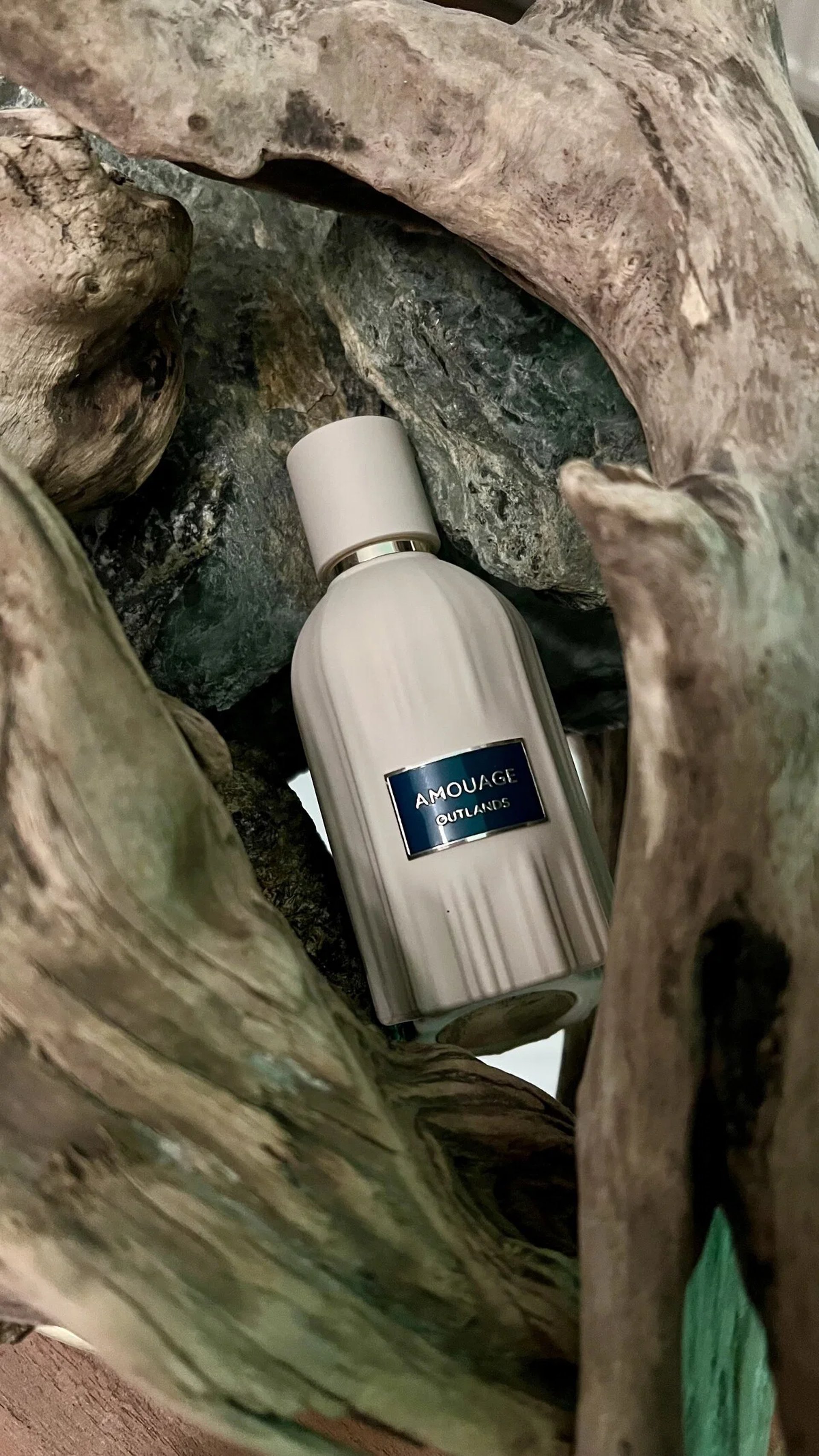
Photographs: Amouage Outlands on travertine · Detail of the Amouage stand with clay flower-shaped piece and glass bell.
María Laura Ortiz Chiavetta — Aroma Storyteller
Winelux Scent & Story