Perfumers as artists
When the story matters as much as the scent
SCENT AND STORY
6/19/2026
By María Laura Ortiz Chiavetta — Aroma Storyteller, Winelux Scent & Story
In the world of contemporary art, there is a concept that curators call "the invisible signature": the idea that a mature artist does not need to sign their work because the work already signs them.
The same thing happens in perfumery. And in very few cases.
Serge Lutens: Silence as a Language
Serge Lutens arrived in perfumery not through chemistry but through image. Photographer, designer, artistic director for Shiseido for decades. His fragrances are, above all, acts of aesthetic will. They are not designed to please — they are built to be.
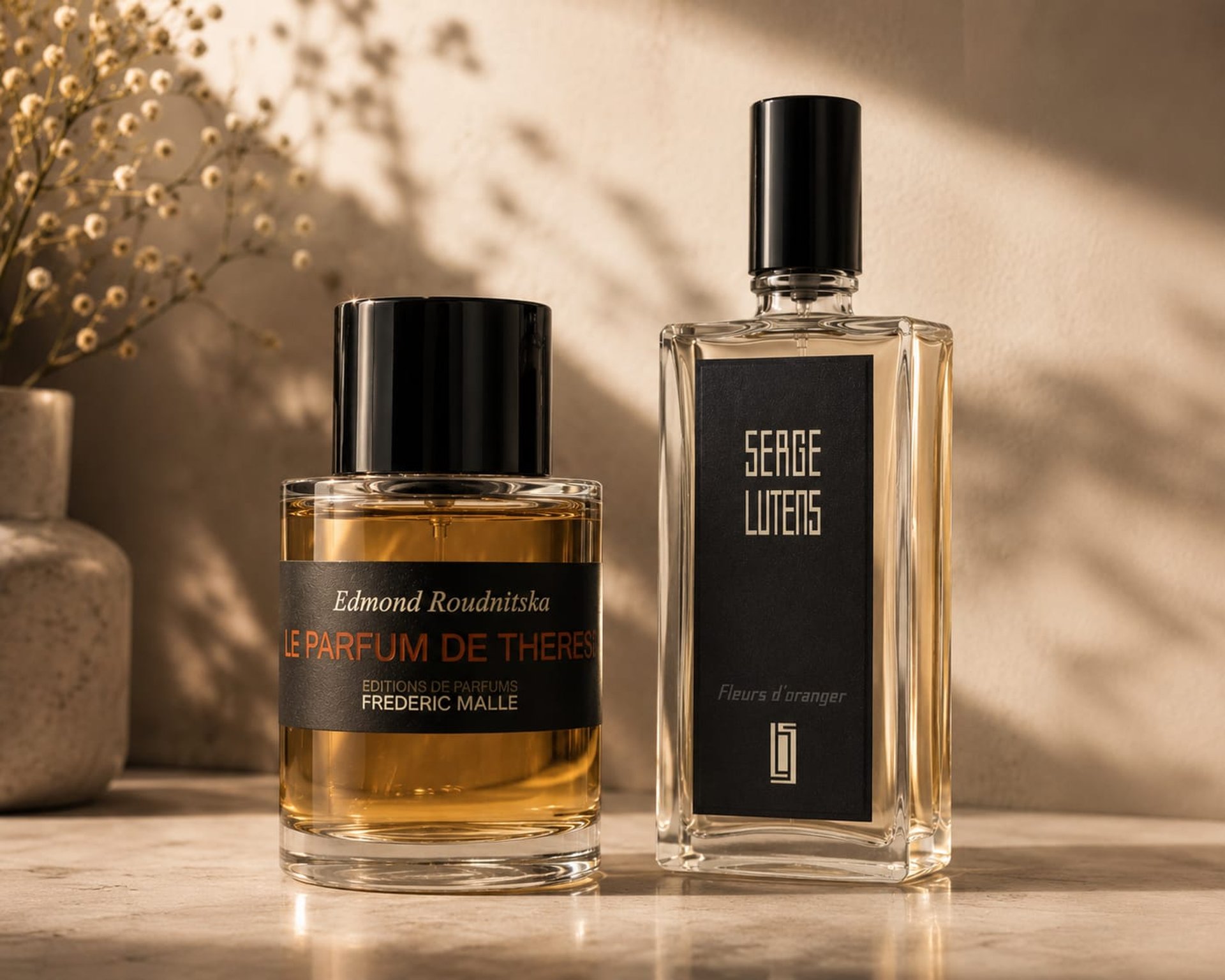
Fleurs d'Oranger is one of his icons: an orange blossom dense, almost indecent in its fullness, with an animalic and warm facet that recalls a Mediterranean night more than an afternoon garden.
What distinguishes Lutens from almost any other creator is that his fragrances never seek approval. They propose.
Frédéric Malle: The Editor Who Changed the Rules
Frédéric Malle is the eye that chooses. His project, Editions de Parfums Frédéric Malle, operates according to the logic of a literary publishing house: he gathers the world's finest perfumers, gives them complete freedom — no commercial brief, no market restrictions — and signs alongside them as an editor signs alongside a writer.
Le Parfum de Thérèse, by Edmond Roudnitska, was originally created for his wife. Malle rescued it and published it the way an unpublished manuscript found in a drawer is published: with reverence and without modifications.
That editorial decision is, in itself, an artistic act.
Andy Tauer: The Chemist Who Found Incense
Andy Tauer is Swiss and came to perfumery through pure chemistry, without formal training. What brought him there was a personal obsession with incense.
His fragrance Rose Kandahar works with Afghan rose — a material extraordinarily difficult to obtain, cultivated only in certain regions of Afghanistan.
That conviction — the belief that the right ingredient justifies any logistical difficulty — is the hallmark of artists in any discipline.
James Healy: The Church as a Sensory Installation
James Healy came to perfumery through design and fashion. His fragrances possess a theatricality that few other houses allow themselves.
Cardinal was born from an installation that recreated the interior of a Catholic church — incense smoke, candle wax, cold stone, the particular silence of sacred spaces.
It is not a fragrance about incense. It is a fragrance about what the body feels when it enters a space filled with incense.
That specificity is what separates craftsmanship from art.
Jessi Park: Art as Grief and as a Gift
The most unexpected story at the Niche Show was that of Elysian Parfum.
Jessi Park did not come from perfumery. She came from the love she had for her sister, who died of cancer. After losing her, she began blending fragrances — not as a project but as a ritual of grief.
Temple of Echo begins in a dark forest — damp, dense, incense and wet stone. And then something changes: milk caramel, saffron, rose. An opening that has been earned. Not an easy resolution.
Jessi Park never studied perfumery.
But she understood that the fragrances that endure are the ones that touch something we recognise as true.
The Question That Unites Them All
What is a fragrance for?
For Lutens: to propose an aesthetic vision of the world.
For Malle: to give the creator the freedom they deserve.
For Tauer: to capture a rare ingredient before it disappears.
For Healy: to reproduce an experience that would otherwise be irreproducible.
For Park: to remain in contact with someone who is no longer here.
The best perfumes are not answers to marketing briefs.
They are answers to questions that someone could not stop asking.
María Laura Ortiz Chiavetta is the founder of Winelux Scent & Story and the author of Diario de Nariz.