

Design, Fashion and Architecture
Wine Conceived Through Aesthetics
2/26/2026
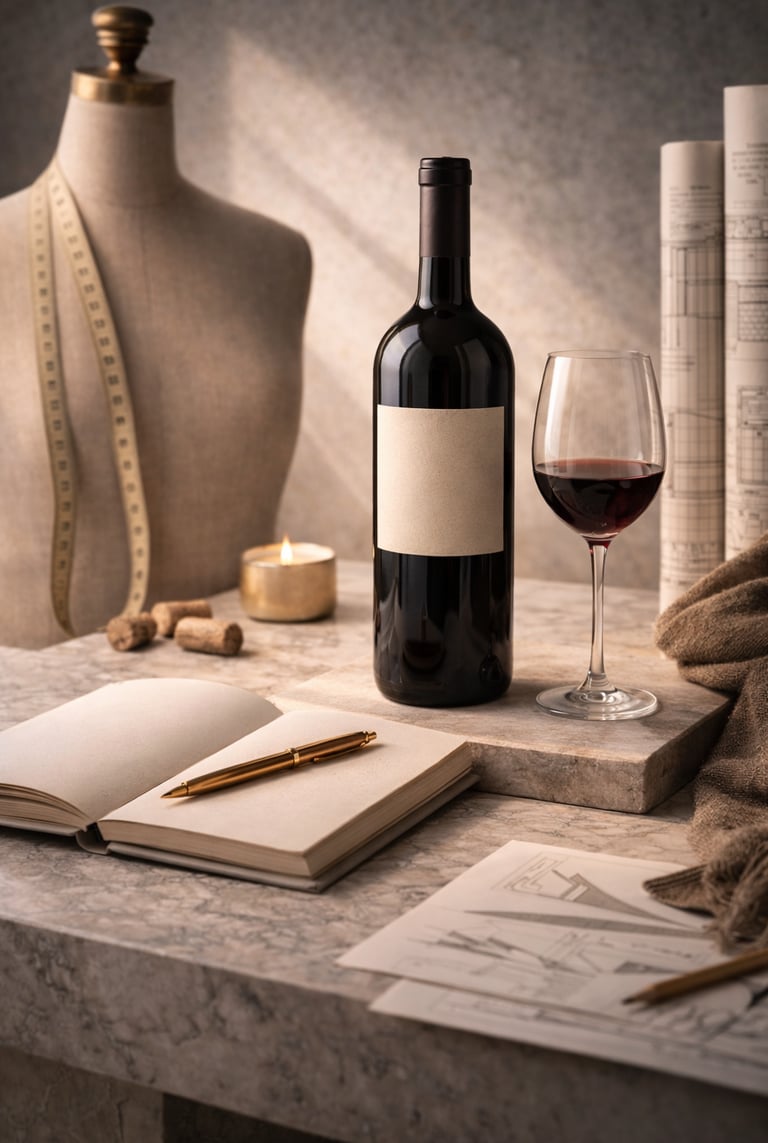
Introduction: Luxury Is Not Only Crafted — It Is Imagined
A fine wine brand is not built solely in the winery. It is also designed through form, space, texture, movement. In essence, through total aesthetics.
In the universe of luxury, design, fashion and architecture are not peripheral expressions: they are languages that amplify, refine and translate a brand’s identity. And when wine allows itself to engage in dialogue with these languages, it ceases to be a product and becomes a symbolic experience.
Wine Is Also Conceived Through the Visual, the Spatial and the Bodily
Aesthetics are not decoration. They are:
A framework of interpretation A generator of immediate emotion A vehicle of differentiation A way of positioning without explanation
A well-designed label, a harmonious tasting room, a capsule that breathes sobriety… all of this speaks before the first sip.
Cheval Blanc (France): architecture, narrative, packaging, silence. Everything communicates in a single tone. Without superlatives. With curated coherence.
What Each Discipline Contributes to the Symbolic Construction of Wine
Design. Typography, geometry, white space, visual rhythm. Design organises the non-verbal message. Example: Penfolds Grange (Australia): its label has never changed, and that gesture itself is symbolic aesthetics.
Fashion. Movement, materiality, curated temporality. Wine also has collections, seasons, textures, a bodily narrative. Example: Dom Pérignon x Iris van Herpen collaboration: an edition that fuses time, form and visual art.
Architecture. Space as symbol. Volume as emotion. Matter as memory. Example: Zuccardi Valle de Uco (Argentina) or L'And Vineyards (Portugal): where architecture moves before tasting.
Why Integrating These Disciplines Reinforces Luxury Perception
Because the sophisticated consumer is interdisciplinary.
Because luxury is perceived through all the senses.
Because it elevates the brand’s visual and symbolic language.
Because it transcends the oenological: it positions you as an aesthetic universe.
Tenuta Ammiraglia – Frescobaldi (Italy): design architecture, sober label, elegant communication. A total integration of aesthetics and contemporary heritage.
Common Mistakes in the Use of Aesthetics in Wine
Confusing modernity with luxury.
Designing without understanding the audience’s emotional tone.
Overloading without rhythm or intention.
Copying trends without symbolic filtering.
The luxury client does not seek immediate visual impact: they seek aesthetic resonance.
Keys to Thinking of Your Wine Brand Through Aesthetics
Curate design as part of identity, not as costume. Does your brand breathe coherence in its forms?
Choose aesthetic references that share your vision. It is not about hiring artists, but about engaging in dialogue with aligned sensibilities.
Design spaces with soul, not just function. Architecture is not scenery: it is structural language.
Think of wine as an experience that is dressed, touched and inhabited — as much as it is drunk.
Conclusion: Brands That Think Through Aesthetics Build Through Emotion
Wine does not need to dress up to pretend. It needs to express itself sensorially with elegance, intention and coherence.
🍷 Because in the universe of luxury, beauty is not superficial: it is the most direct path to the symbolic.
