

Bordeaux 2025
The vintage that chose balance over power
6/11/2026
There is a moment in every great wine region's history when the conversation shifts. Not from bad to good, but from one definition of excellence to another. Tasting through Bordeaux 2025 en primeur in Madrid this week, I kept returning to a single word that producers used with unusual consistency: balance.
This was not the vintage they expected after the punishing mildew losses of 2024 — a year when some estates lost up to 80% of their Merlot crop and yields collapsed to nearly half of typical levels. What 2025 delivered instead was a reset: a growing season that allowed winemakers to achieve concentration without surrendering freshness, structure without sacrificing texture, and alcohol levels that stayed genuinely moderate.
The Contrast That Makes 2025 Legible
To understand what 2025 represents, the comparison with 2018 and 2019 is essential. Those were warm, celebrated vintages — powerful, concentrated, age-worthy. And they are. But tasting Domaine de Chevalier 2018 and 2019 this week against 2025 projections revealed something instructive: the warm vintages produced wines where tannin and barrel still need time to integrate, where the oak signature remains present, where the structure is impressive but the harmony is still arriving.
The 2025s, by contrast, showed tannins that were already speaking the same language as the fruit. Not softer — more precise. Château Clinet 2025 arrived fresh, fluid, structured and balanced in a single gesture. Léoville Las Cases' Petit Lion 2025 showed deep colour with blue tints, vibrant red fruit and delicate tannins with real freshness. Even Château Nénin, whose 2025 showed a slightly short finish, demonstrated the hallmark of the vintage: fine, well-integrated tannins with a genuinely Pomerol expression.
This is what a generational shift in viticulture looks like when it succeeds: not making warm years cooler, but learning to read them differently.
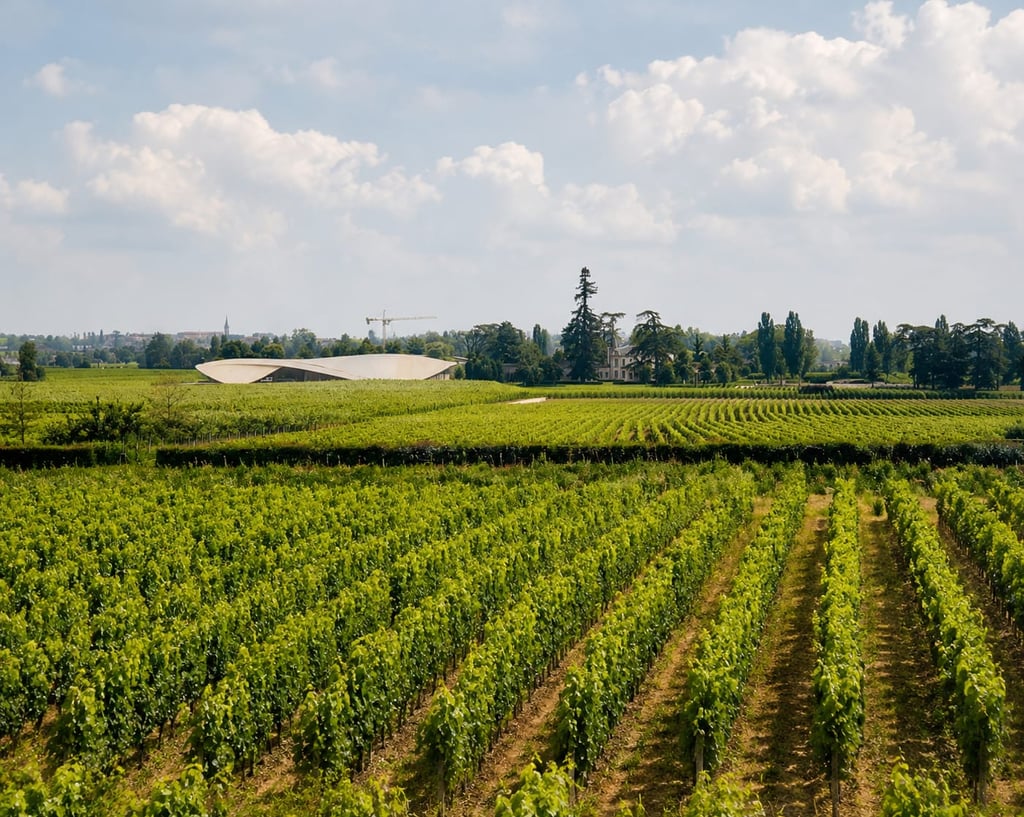
View from Château Dominique terrace towards Château Cheval Blanc. Saint-Émilion, April 2025 — the harvest that produced the vintage now in primeur.
The Technical Signals
Several data points across the tastings pointed in the same direction. At Château Talbot, the 2020 blend included an unusually high 9% Petit Verdot — against a typical 4–5% — reflecting a year when that variety reached exceptional maturity. The 2025 comparisons highlighted instead a vintage where Cabernet Sauvignon delivered its structure without requiring varietal correction. At Château Canon, the progressive technical shift underway since 2015 — reduced new oak to 60%, introduction of 900-litre foudres and cement tanks from 2020 onwards — found in 2025 a vintage that rewarded restraint. Less intervention, more terroir legibility.
At Château de Ferrand, on the second-highest point of Saint-Émilion with clay-limestone subsoil that retained water through the hot August conditions, yields held significantly better than neighbours on sandy soils — Cheval Blanc and Le Pin recorded around 16 hectoliters per hectare while clay-limestone properties maintained relatively stronger output. The 2025 vintage here is described by the estate as one of their finest: precision, balance, fantastic tannins.
The 2024 organic certification at several Bordeaux estates — including the Chanel-owned properties and Château de Ferrand with its new label linked to the first fully organic vintage — added another layer of meaning. These are not unrelated events. The push toward organic viticulture, the reduction of new oak, the embrace of cement and large-format vessels: they all point to the same ambition, which is wines that speak more clearly of where they come from.
What 2025 Means for the Market
En primeur logic has always been about trust in the future. Buying 2025 now means buying the argument that this vintage will reward patience in a way that the warm, extracted years of the recent past did not always manage. The producers I spoke with were unusually confident — not with the enthusiasm of marketing, but with the measured certainty of people who had watched their vines through a full season and understood what they had.
The new-generation winemakers of Bordeaux did not make 2025 great by accident. They made it great because they have spent a decade learning how to manage warmth without surrendering elegance. The vintage is the result, not the cause.
For the international wine trade and for collectors, 2025 offers something the market has been waiting for: a Bordeaux vintage where the word balance is not a consolation but a definition.
